Absolutely. I’ll rewrite it as a professional BBC-style feature article: neutral, authoritative, readable, less promotional, with stronger editorial flow and SEO-friendly headings. I’ll also reduce repetition, avoid exaggerated claims, and make the TODDLE section feel natural rather than like an advertisement.
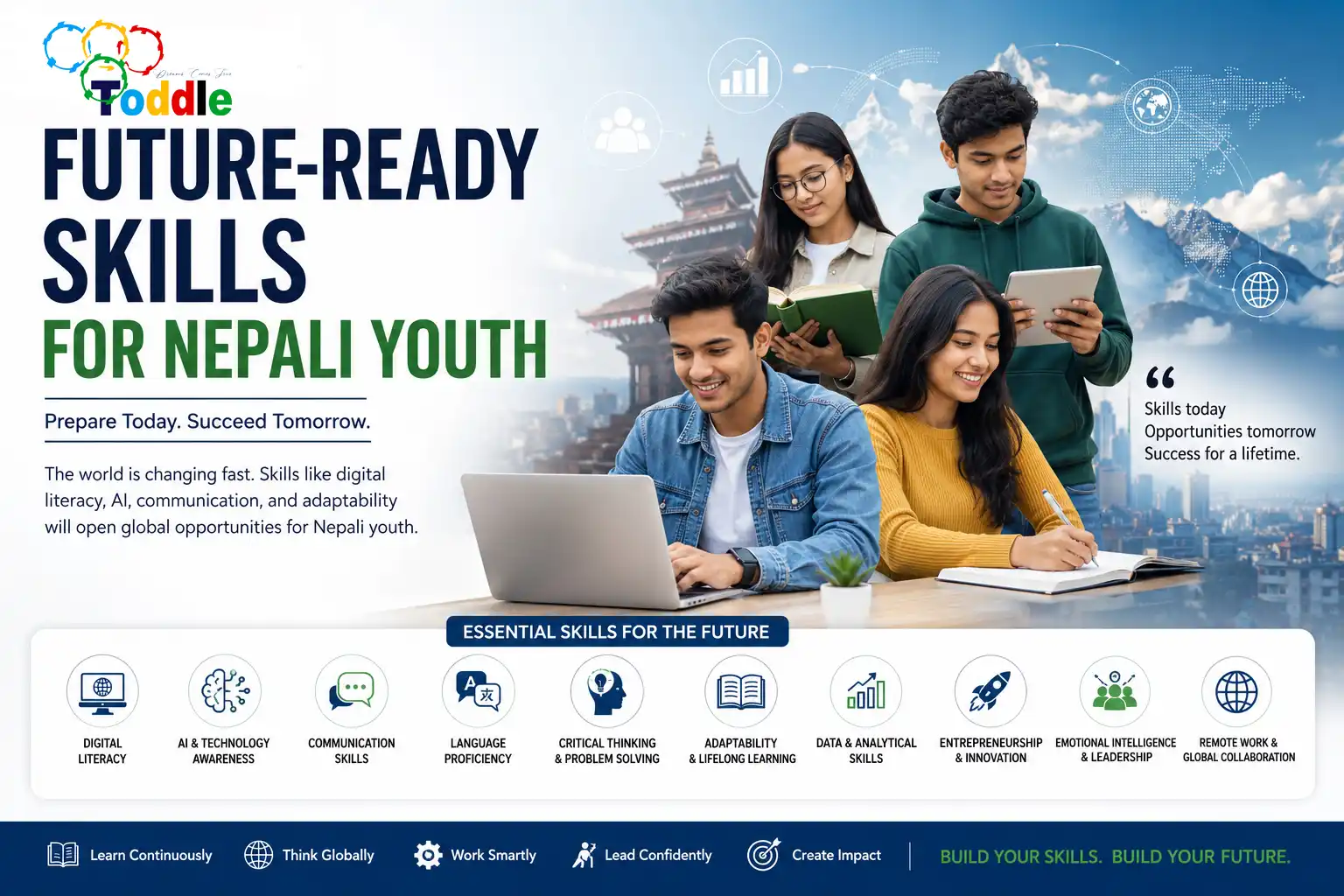
Future-Ready Skills: What Nepali Young People Need for the Changing World of Work
Nepal has a young population entering the workforce every year. For many, gaining a university degree remains an important step towards employment and professional success.
But as technology reshapes workplaces and employers increasingly operate across borders, academic qualifications alone may not be enough.
Young people are being asked to do more than demonstrate what they have studied. They need to communicate effectively, use digital tools, solve problems, work with people from different backgrounds and adapt when technology or job requirements change.
For Nepali students and young professionals, this shift creates both a challenge and an opportunity.
Whether someone wants to build a career in Nepal, study overseas, work for an international organisation, start a business, freelance or work remotely, developing future-ready skills can help them respond to a changing labour market.
What are future-ready skills?
Future-ready skills are the knowledge, abilities and personal qualities that help people remain effective as the workplace evolves.
They include:
-
Digital literacy
-
Artificial intelligence awareness
-
Communication
-
English and foreign-language skills
-
Critical thinking
-
Problem-solving
-
Data literacy
-
Adaptability
-
Entrepreneurship
-
Leadership
-
Emotional intelligence
-
Remote collaboration
-
Lifelong learning
The idea is not to predict exactly which jobs will exist in 10 or 20 years.
Instead, it is about developing the ability to learn, adapt and apply new skills throughout a career.
That may prove more valuable than preparing for one occupation and assuming it will remain unchanged.
Why future-ready skills matter for Nepali youth
The world of work is becoming increasingly connected.
A company in Kathmandu may work with clients in another country. A Nepali designer may work remotely for an international business. A student may study in South Korea or Japan before pursuing an international career. A small business may use digital platforms to reach customers far beyond its local market.
At the same time, artificial intelligence and automation are changing how many routine tasks are performed.
Employers therefore increasingly value people who can combine technical knowledge with human skills.
They may need employees who can:
-
Use technology confidently
-
Communicate clearly
-
Analyse information
-
Solve practical problems
-
Learn new tools quickly
-
Work independently
-
Collaborate with others
-
Adapt to new responsibilities
-
Use artificial intelligence responsibly
For young Nepalis, developing these abilities can open pathways to employment, entrepreneurship, international education and remote work.
The important shift is from thinking only about qualifications to thinking about capabilities.
1. Digital literacy
Digital literacy has become a basic requirement in many areas of modern working life.
People working in education, finance, healthcare, tourism, engineering, government, business or marketing are increasingly expected to interact with digital systems.
Useful digital skills include:
-
Computer and smartphone use
-
Internet research
-
Professional email
-
Word processing and spreadsheets
-
Cloud-based tools
-
Online collaboration platforms
-
Digital content creation
-
Basic cybersecurity awareness
-
Verifying information found online
Digital literacy is not simply about knowing how to operate a computer.
It also means understanding how to use technology safely, efficiently and appropriately.
For young professionals, this can provide a foundation for learning more advanced technologies later.
2. Artificial intelligence and AI literacy
Artificial intelligence is moving from specialist research laboratories into everyday workplaces.
It is already being used in areas such as customer service, marketing, software development, education, research, finance and data analysis.
For young people, understanding AI does not necessarily mean becoming a machine-learning engineer.
A more immediate priority may be learning how AI tools work, where they can be useful and where their limitations lie.
Important areas include:
-
Basic AI concepts
-
AI-assisted research
-
Prompt writing
-
Productivity tools
-
Data analysis
-
Evaluating AI-generated information
-
Understanding accuracy and bias
-
Responsible use of AI
AI can help people generate ideas, analyse information and automate repetitive tasks. But users still need to check the information produced and make appropriate decisions.
The ability to work with AI, rather than simply compete against it, is likely to become increasingly important.
3. Communication skills
Technology may change how people work, but communication remains a fundamentally human ability.
A technically capable employee may still struggle if they cannot explain an idea clearly, listen to colleagues or communicate with clients.
Strong communication includes:
-
Clear speaking
-
Professional writing
-
Presentation skills
-
Active listening
-
Negotiation
-
Team communication
-
Public speaking
-
Cross-cultural communication
These abilities can matter during job interviews, university applications, workplace meetings, presentations and international projects.
Technical knowledge becomes more useful when people can explain that knowledge to others.
4. English and foreign-language skills
Language can influence access to education, employment and international networks.
For many Nepali students and professionals, English remains particularly important. It is widely used in higher education, research, technology, international business and professional communication.
Learning an additional language can create further opportunities.
Depending on career and study plans, young people may consider languages such as:
-
Korean
-
Japanese
-
Chinese
-
German
-
French
For students planning to study or work in South Korea, Korean can be particularly useful for everyday communication, academic life and workplace integration.
Students entering Korean-language-related academic programmes may also encounter TOPIK, the Test of Proficiency in Korean, depending on their institution and course.
Foreign-language learning should therefore not be viewed only as an academic exercise. It can also become a practical skill for international mobility and career development.
5. Critical thinking and problem-solving
Information is easier to access than ever before.
The challenge is knowing what to believe.
Social media, search engines and artificial intelligence can produce enormous amounts of information, but not all of it is accurate or useful.
Critical thinking helps people assess information before acting on it.
A strong critical thinker can:
-
Question assumptions
-
Compare different viewpoints
-
Examine evidence
-
Identify unreliable information
-
Recognise potential problems
-
Make informed decisions
-
Develop practical solutions
Problem-solving is equally important.
Whether someone works in agriculture, healthcare, education, hospitality, engineering, technology or business, the ability to identify a problem and find a workable solution can add considerable value.
6. Adaptability and lifelong learning
Perhaps the most important future-ready skill is the ability to keep learning.
Technology changes. Businesses change. Consumer behaviour changes. Entire industries can change.
As a result, the skills that matter at the beginning of someone's career may not be the same skills they need later.
Adaptable professionals are more prepared to:
-
Learn new technologies
-
Change working methods
-
Take on new responsibilities
-
Move into new roles
-
Learn from mistakes
-
Respond to changes in their industry
-
Develop new professional capabilities
Instead of asking:
“What job will I have for the rest of my life?”
young people may benefit from asking:
“What skills will help me continue to succeed as work changes?”
That mindset turns learning into an ongoing part of a career rather than something that ends with graduation.
7. Data and analytical skills
Data has become an important part of decision-making.
Businesses, governments, universities, hospitals and financial institutions use data to understand customers, identify problems, measure performance and plan for the future.
Not everyone needs to become a data scientist.
But basic data literacy can be useful in almost any profession.
It may include:
-
Spreadsheet skills
-
Basic statistics
-
Data interpretation
-
Research methods
-
Data visualisation
-
Business analytics
-
Evidence-based decision-making
A professional who can understand information, identify patterns and explain what the numbers mean may be better equipped to make sound decisions.
8. Entrepreneurship and innovation
A successful career does not always have to follow the traditional route from education to employment.
Some young people may become entrepreneurs, freelancers, consultants, creators or independent professionals.
Entrepreneurial skills include:
-
Identifying opportunities
-
Understanding customer needs
-
Business planning
-
Financial literacy
-
Marketing
-
Sales
-
Leadership
-
Innovation
-
Risk assessment
-
Strategic thinking
Entrepreneurship can also contribute to Nepal's wider economy by creating businesses, generating employment and developing solutions to local problems.
This encourages a different question.
Instead of asking only:
“Where can I find a job?”
young people can also ask:
“What problem can I solve?”
9. Emotional intelligence and leadership
As technology becomes more capable, human skills remain important.
Emotional intelligence involves recognising and managing one's own emotions while understanding and responding appropriately to other people.
It can support:
-
Teamwork
-
Empathy
-
Conflict resolution
-
Relationship building
-
Workplace communication
-
Stress management
-
Leadership
Leadership is not limited to people with managerial titles.
A student organising a project, an employee coordinating colleagues or an entrepreneur managing a small business may all need leadership skills.
The professionals best prepared for the future are likely to combine technical competence with strong interpersonal abilities.
10. Remote work and global collaboration
Digital communication has made it possible for some professionals to work with organisations and clients in other countries without relocating.
For Nepali workers, this can create opportunities in areas such as:
-
Software development
-
Graphic design
-
Digital marketing
-
Content creation
-
Virtual assistance
-
Online education
-
Customer support
-
Consulting
-
Freelancing
-
International project work
But remote work requires more than technical ability.
Successful remote professionals also need:
-
Time management
-
Self-discipline
-
Professional communication
-
Online collaboration
-
Project management
-
Independent working skills
-
Cross-cultural understanding
-
Reliable digital infrastructure
Working remotely can reduce the importance of geographical location for some professions.
But it increases the importance of reliability, communication and demonstrable skills.
Career areas Nepali youth can explore
There is no single list of “future jobs” that will guarantee success.
However, young people can explore opportunities in sectors influenced by technology, globalisation and changing consumer needs.
These may include:
-
Information technology
-
Artificial intelligence
-
Software development
-
Cybersecurity
-
Data analytics
-
Digital marketing
-
Engineering
-
Healthcare
-
Education
-
Research
-
International business
-
Tourism and hospitality
-
Creative industries
-
Entrepreneurship
-
Freelancing
-
Remote international work
The right choice will depend on an individual's interests, abilities, education and the demand for particular skills.
Rather than chasing a job simply because it is described as a “future career”, students should consider the combination of interest, ability, market demand and willingness to keep learning.
How Nepali students can start building future-ready skills
Developing future-ready skills does not have to wait until university graduation.
Students can begin with relatively small steps.
Build digital confidence
Learn to use productivity software, spreadsheets, online collaboration platforms, cloud services and digital research tools.
Understand artificial intelligence
Explore appropriate AI tools for learning, research and productivity while developing the habit of checking AI-generated information.
Improve communication
Practise professional writing, presentations, interviews, public speaking and teamwork.
Learn languages
Strengthen English and consider another language that matches your education or career plans.
Build practical projects
Certificates can demonstrate that someone completed a course. Projects can demonstrate what they can actually do.
Students can create websites, portfolios, presentations, research projects, business ideas, digital content or other practical work related to their interests.
Develop professional habits
Time management, reliability, teamwork, responsibility and problem-solving can influence professional success just as much as technical knowledge.
Keep learning
Follow developments in your chosen field and regularly update your skills.
A useful cycle is:
Learn → Practise → Apply → Improve → Repeat.
How TODDLE Multipurpose Company supports future-ready learning
For education and career-focused organisations, preparing students for the future involves more than helping them obtain academic qualifications.
TODDLE Multipurpose Company focuses on educational guidance, career counselling, language learning, international study opportunities and professional development.
Its broader approach is built around helping students understand their options and prepare for the practical demands of education and employment.
For students considering international education, this can include developing communication and language abilities, understanding different education systems, preparing for overseas study and thinking about longer-term career goals.
The underlying principle is straightforward: education should not end with obtaining a qualification.
Students also need the confidence and practical abilities to use what they have learned.
The future belongs to adaptable learners
No one can predict exactly what the workplace will look like in the coming decades.
New technologies will emerge. Existing professions will change. Some routine tasks will become automated, while new responsibilities and industries will develop.
For young people in Nepal, the most useful response may not be trying to predict every change.
It is to become better prepared for change itself.
A combination of digital literacy, AI awareness, communication, language proficiency, critical thinking, data skills, adaptability, entrepreneurship, emotional intelligence and global collaboration can provide a strong foundation.
A degree can open a door.
Skills can help you walk through it.
And continuous learning can help you keep moving forward.
The future is not something young people simply wait for.
It is something they prepare for today.
For Nepal's young generation, that preparation could mean learning new technologies, developing practical abilities, gaining international exposure, building professional networks and finding better ways to solve problems.
The goal is not simply to find a job.
It is to develop the ability to create value, adapt to change and build a meaningful career wherever opportunities arise.
Learn today. Adapt tomorrow. Build the future.