Introduction: The Section That Decides More Than People Expect
Ask most EPS-TOPIK candidates which section worries them more, and the honest answer is almost always the same: listening. Reading gives you something to look at, re-read, and reason through at your own pace within the time limit. Listening gives you one shot — a voice plays, and whatever you catch or miss in those seconds is what you're working with when the question appears.
That pressure is exactly why the listening section deserves focused, structured preparation rather than being treated as a smaller cousin of reading. It carries equal weight in the exam's overall score, it tests a genuinely different skill (real-time processing, not just vocabulary recall), and it's the section where candidates most often say their actual test-day experience surprised them — faster speech, unfamiliar accents on audio recordings, or simply losing focus for a few seconds and missing the one detail a question hinged on.
This guide walks through exactly what the EPS-TOPIK listening section looks like — its format, its content, its question types — and lays out a practical, honest preparation approach built around how the section actually works, not around vague advice to "listen to more Korean."
What the EPS-TOPIK Listening Section Actually Is
The listening section (듣기 시험) is one of two skill sections that make up the EPS-TOPIK exam, alongside reading. It's developed and administered by HRD Korea (Human Resources Development Service of Korea) on behalf of Korea's Ministry of Employment and Labor, as part of the broader Employment Permit System (EPS) used to select foreign workers for jobs in Korean manufacturing, agriculture, construction, fishing, and service-sector roles.
Unlike the general academic TOPIK exam — which tests conversational, academic, and even literary Korean across six proficiency levels — EPS-TOPIK listening is built entirely around practical, functional Korean: the kind of language you'd actually hear from a supervisor, a coworker, a landlord, a doctor, or a public announcement in Korea. It doesn't test poetry, news broadcasts, or formal lectures. It tests whether you can understand instructions, follow a conversation about daily logistics, and pick up the kind of detail that matters for staying safe and functional at work and in daily life.
Current EPS TOPIK Listening Section Format
For the current EPS-TOPIK cycle, the listening section is structured as follows:
| Feature | Detail |
|---|---|
| Number of questions | 20 questions |
| Marks allocated | 50 marks (out of 100 total for the full exam) |
| Time allowed | 25 minutes |
| Question format | Multiple choice, 4 answer options per question |
| Delivery | Computer-Based Test (CBT) or Tablet-Based Test (UBT), audio played through headphones |
| Position in exam | First section, immediately followed by reading with no break |
The listening section sits alongside an equally weighted reading section — together forming a 40-question, 100-mark, 50-minute exam. Because listening comes first, how you handle it directly affects your mental state and pacing going into reading immediately afterward, which is one more reason it deserves deliberate, calm preparation rather than last-minute cramming.
A note on older material you may come across: some circulating study guides and older PDFs describe a listening section with 25 questions worth 100 marks over 30 minutes, as part of a wider 200-mark, 70-minute exam. This reflects an earlier paper-based (PBT) version of EPS-TOPIK used in previous years. The exam format has been streamlined and moved to computer-based delivery since then. If you're using older practice material, the content and question style are usually still reasonably good practice — but don't assume the section length, timing, or number of questions matches what you'll face on your actual test day. Always confirm the current format against your specific application round's official notice.
How Many Times Does the Audio Play?
This is one of the most-asked practical questions about the listening section, and it's worth being straightforward: there is genuine inconsistency in how this is described across different study resources. Some describe each audio item as playing only once, demanding an immediate, first-pass answer. Others describe a two-playback structure, with a short pause between the first and second play of each track, giving candidates a chance to catch what they missed the first time.
Rather than picking one figure to state with false confidence, the most reliable approach is this: treat every listening item as if it will only play once, and let any second playback (if your specific test session includes one) work in your favor as a bonus rather than something you're counting on. This mindset does two useful things — it forces you to build genuine first-pass listening comprehension rather than a habit of waiting for a repeat, and it protects you from panic if your actual test session turns out to allow only a single playback. Confirm the exact playback rule for your specific exam round through your official test-day instructions or your preparation class, since this is exactly the kind of operational detail that can shift between cycles and delivery formats (CBT vs UBT).
What the EPS TOPIK Listening Section Actually Covers
The listening section draws its content directly from HRD Korea's own Standard Textbook for EPS-TOPIK, which is built around real occupational structures and daily-life situations migrant workers commonly encounter. The content generally falls into a few recurring domains:
- Workplace instructions and safety. Short audio clips where a supervisor or colleague gives an instruction, a warning, or a safety reminder — the kind of thing you'd hear on a factory floor, in a warehouse, on a farm, or on a construction site.
- Daily life logistics. Conversations and short monologues about shopping, using transportation, visiting a clinic or hospital, banking, or dealing with everyday errands and appointments.
- Social interactions and greetings. Basic exchanges between coworkers, neighbors, or acquaintances — greetings, small talk, polite requests, and simple social courtesies.
- Announcements and notices. Short, formal announcements — the kind you might hear over a workplace PA system, at a company event, or in a public space — covering things like schedule changes, event details, or general notices.
- Emergency and safety scenarios. Instructions or warnings related to accidents, hazards, or urgent situations, testing whether a candidate can understand and react appropriately to safety-critical spoken Korean.
A useful way to think about this content mix: almost nothing on the listening section is abstract or academic. Nearly everything ties back to a concrete, physical, real-world scenario a foreign worker in Korea would plausibly face. That's genuinely good news for preparation — it means your vocabulary and listening practice can be tightly focused rather than open-ended.
Question Types You'll Actually Encounter
Based on the Standard Textbook's practice structure and HRD Korea's official open question bank, listening items generally fall into a handful of recurring question types:
- Identify what was said. A short clip plays — a single sentence, an instruction, or a short exchange — and the question asks you to select the option that matches what was actually said or requested.
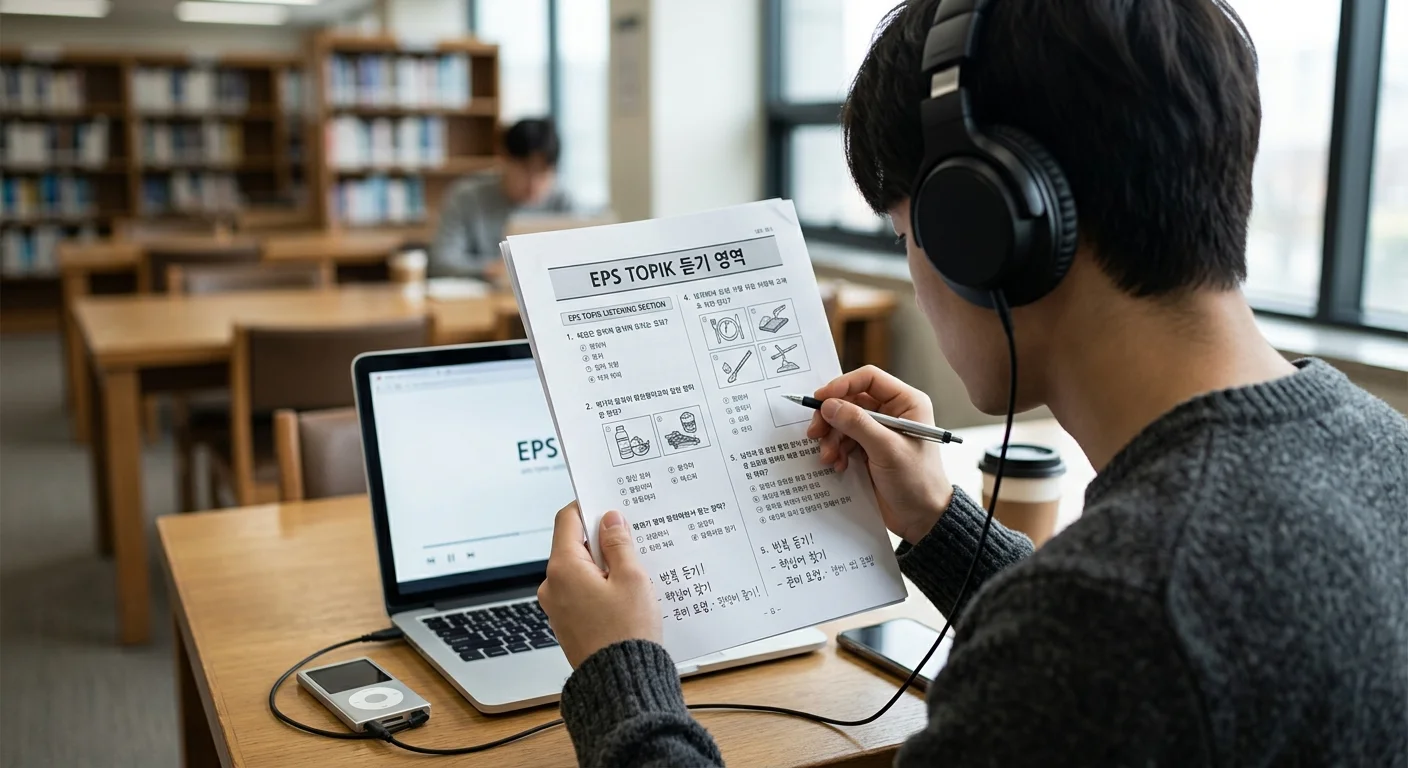
- Match audio to the correct picture. An instruction or description plays, and you choose the image among four options that correctly matches it. This format tests whether you understood specific action words, object names, or spatial/directional language (move this here, put that there, take this to warehouse B).
- Detail recognition from a short dialogue. Two speakers have a brief exchange — discussing a schedule, a task, a symptom, a plan — and the question asks about a specific detail mentioned: a time, a place, a quantity, or a name.
- Inference — next action or intent. Rather than asking what was literally said, these questions ask what will likely happen next, why the speakers are talking, or what one of them is likely to do based on the context of the conversation. This is the most cognitively demanding question type, because it requires you to understand the conversation's underlying logic, not just individual words.
- Numbers, times, and quantities. A recurring and high-value category — Korean number systems (both native Korean and Sino-Korean numbers, used in different contexts) show up constantly in workplace and daily-life audio: deadlines, quantities, prices, phone numbers, and dates. Candidates who haven't specifically drilled number listening often lose otherwise avoidable marks here.
| Question Type | What It Tests | Example Scenario |
|---|---|---|
| Direct statement identification | Literal comprehension | A supervisor gives a one-line instruction; you select the matching option |
| Picture matching | Vocabulary + spatial/action language | An instruction to move an item plays; you choose the correct image |
| Detail recognition | Specific fact extraction | A dialogue mentions a time and place; you're asked what time the meeting is |
| Inference (next action / intent) | Contextual reasoning | A conversation implies one speaker will visit a clinic; you identify the likely next step |
| Numbers and quantities | Numerical listening accuracy | An announcement gives a deadline or quantity; you select the matching figure |
Why Korean Sounds Different From How It's Written: The Core Pronunciation Rules
This is, without question, one of the biggest gaps between how self-study candidates prepare and what the listening section actually demands. Many candidates study vocabulary and grammar entirely through text — flashcards, written sentences, translated word lists — and then are genuinely thrown off on exam day because natural spoken Korean doesn't sound the way the written form suggests it should.
Korean has a set of regular, predictable sound-change rules that affect how connected speech actually sounds. Understanding these isn't optional background knowledge — it's directly responsible for whether you can follow real audio at a normal speaking pace.
- Liaison (연음 법칙). When a syllable ending in a consonant (받침, batchim) is followed by a syllable starting with a vowel, that final consonant sound shifts onto the next syllable. This is why 한국어 (Korean language) is pronounced closer to "Han-gu-geo" rather than sounding out each syllable block separately. Liaison happens constantly in natural speech and is one of the first things that makes spoken Korean feel faster and more "joined together" than textbook Korean.
- Nasalization (비음화). Certain consonants — particularly ㅂ, ㄷ, and ㄱ — shift their sound when they appear before a nasal consonant like ㄴ or ㅁ. A common example is 합니다 (a polite verb ending), which is pronounced closer to "Ham-ni-da" rather than a literal syllable-by-syllable reading. This shows up constantly in formal and polite speech — exactly the register EPS-TOPIK listening audio frequently uses.
- Aspiration (격음화). When a plain consonant sits next to ㅎ, the two often merge into a single aspirated (breathier) sound. 축하 (congratulations) is a commonly cited example, pronounced closer to "Chu-ka" rather than as two cleanly separated syllables.
- Tensification (경음화). In certain grammatical and phonetic environments, plain consonants shift into "tense," doubled-sounding consonants. 학교 (school) is a frequently cited example, pronounced closer to "Hak-kkyo."
None of these rules are exotic or advanced — they're standard, everyday features of spoken Korean that any native speaker uses automatically. The problem for exam candidates isn't that these rules are difficult to learn; it's that many self-study candidates never explicitly study them at all, and then wonder why real audio "sounds faster" or "sounds different" than what they practiced with. Spending even a few focused study sessions specifically on these four patterns — with audio examples, not just written explanations — measurably improves how much of a natural-speed conversation you can actually follow.
Vocabulary Domains Worth Prioritizing
Given how tightly the listening content clusters around workplace and daily-life scenarios, vocabulary preparation is far more effective when it's organized by domain rather than studied as one long undifferentiated list.
A reasonably comprehensive domain breakdown looks like this:
| Domain | Example Vocabulary Areas |
|---|---|
| Workplace instructions | Action verbs (move, lift, carry, place, stop, start), directional words (left, right, forward, up, down), tools and equipment names |
| Safety and warnings | Danger, caution, emergency, evacuate, protective equipment, injury-related terms |
| Time and schedule | Days, dates, clock time, deadlines, "before/after," native vs. Sino-Korean number systems |
| Quantities and measurements | Counting units for different objects, weights, amounts, prices |
| Daily life logistics | Transportation terms, shopping vocabulary, banking terms, basic healthcare vocabulary |
| Social interaction | Greetings, polite requests, apologies, basic small talk expressions |
| Workplace relationships | Terms for supervisors, colleagues, job titles, and common workplace hierarchy language |
A practical tip: Korean uses two different number systems depending on context (native Korean numbers for counting objects, ages, and hours; Sino-Korean numbers for dates, money, and minutes, among other uses). Candidates who haven't specifically drilled which system applies in which context often mishear or misinterpret numeric details under time pressure — and since numbers show up constantly in workplace and daily-life audio, this is a high-value, narrowly focused area to master early in your preparation.
A Realistic, Illustrative Walkthrough
To make the format concrete without reproducing any actual copyrighted exam content, here's the general shape a listening item takes, based on the recurring patterns described above:
A short audio clip plays: a supervisor tells a worker, "Move the boxes to warehouse B before lunch." The question then asks what the worker was instructed to do, with four short picture or text options — only one correctly showing boxes being moved to warehouse B.
And an inference-style item follows a different logic:
Two coworkers have a short exchange: one mentions feeling unwell, and the other suggests going to see a doctor after their shift. The question asks what the first speaker is likely to do next — testing whether you followed the conversation's underlying logic, not just individual words.
This is the practical, situational level the listening section actually operates at — never abstract, never academic, always tied to a scenario a foreign worker in Korea would plausibly encounter.
Time Management Inside the EPS TOPIK Listening Section
With 20 questions and 25 minutes, and audio pacing largely dictating the section's rhythm rather than letting you move at your own pace the way you can in reading, time management here looks different from reading-section strategy. A few principles that consistently help:
- Read the answer options before the audio starts, whenever the interface allows it. Knowing what you're listening for narrows your focus immediately, rather than trying to process the full audio and then figure out what's being asked afterward.
- Don't freeze on one missed detail. If you miss a specific word or number partway through a clip, keep listening for the rest of the context rather than mentally replaying the missed word — you can often still work out the correct answer from surrounding context even with one gap.
- Answer immediately after each item, then move on. Because the section is paced by audio playback rather than free navigation, dwelling on a question after its audio has finished usually costs you preparation time for the next item rather than actually improving your answer.
- Use any brief gaps between audio items to mentally reset, rather than second-guessing an answer you've already selected.
- Stay physically still and focused during playback. This sounds obvious, but candidates who fidget with test materials, look around the room, or get distracted by neighboring test-takers during a 25-minute continuously-paced section lose real comprehension time they can't get back.
Common Mistakes in the EPS TOPIK Listening Section
Pulling together patterns that show up repeatedly among candidates preparing for this section:
- Studying only written Korean and treating listening as an afterthought. As covered above, the sound-change rules mean text-only study leaves a real gap between what you've practiced and what natural audio sounds like.
- Panicking after missing one word and losing the rest of the clip. A single missed detail doesn't mean the whole answer is lost — context often still gets you there if you stay calm and keep listening.
- Never practicing with real background noise or test-like conditions. Practicing listening in a perfectly quiet room with full attention doesn't prepare you for the mild stress and unfamiliar environment of an actual test center.
- Ignoring number and time vocabulary until late in preparation. Since these appear constantly and are a narrowly learnable skill, leaving them until the final week wastes weeks of available practice time.
- Not timing practice sessions realistically. Casual, untimed listening practice builds comprehension but doesn't build the specific skill of deciding on an answer within a tightly paced section.
- Relying entirely on one accent or speaking pace. Standard Korean textbook audio is often recorded slowly and clearly; exam audio may include more natural, faster-paced speech. Practicing exclusively with slow, textbook-style audio can leave a gap on test day.
- Skipping mock exams until the very end. A full, timed mock listening section — done under realistic conditions — reveals pacing and concentration issues that isolated topic drills simply don't expose.
Building Listening Skills: A Structured Preparation Approach
Rather than vague advice to "listen to more Korean," here's a more structured way to think about building this specific skill over a meaningful preparation window. This isn't a rigid schedule so much as a sequencing logic — adjust the pace to how much time you actually have before your exam date.
Phase 1 — Foundation (first stretch of preparation). Work through the Standard Textbook's early chapters in order, paying close attention to the Conversation and Vocabulary and Expressions sections in each. At this stage, prioritize understanding over speed — it's fine to replay audio multiple times and check meanings as you go. This is also the right time to explicitly study the four sound-change rules described earlier, using audio examples rather than just reading about them.
Phase 2 — Domain-focused vocabulary building. Move through the vocabulary domains listed above systematically — workplace instructions, safety terms, numbers and time, daily-life logistics — rather than studying randomly. At this stage, start listening to audio without looking at the transcript first, then checking afterward, to build genuine first-pass comprehension rather than reading-assisted listening.
Phase 3 — Question-type drilling. Begin working through HRD Korea's official open question bank and the Standard Textbook's chapter-end EPS-TOPIK practice questions, organized by question type (detail recognition, inference, picture matching) rather than working through them in random order. This helps you notice which specific question type you're weakest at, rather than getting a blurred overall sense of "listening is hard."
Phase 4 — Timed, full-section practice. Start taking complete, timed 25-minute listening sections under conditions as close to the real exam as possible — headphones, no pausing, no replaying beyond whatever your actual test format allows. Review every mistake afterward and identify whether it was a vocabulary gap, a sound-change/pronunciation issue, or a pacing/concentration issue, since each of those has a different fix.
Phase 5 — Final consolidation. In the last stretch before your exam date, shift toward full timed mock exams (listening and reading together, exactly as the real test runs, with no break between sections) rather than isolated listening drills. This builds the specific stamina and focus transition needed to move straight from a 25-minute listening section into a 25-minute reading section without a mental reset in between.
| Phase | Focus | What "Done" Looks Like |
|---|---|---|
| 1. Foundation | Textbook chapters + sound-change rules | Comfortable reading textbook dialogues and recognizing rule patterns in slow audio |
| 2. Vocabulary building | Domain-specific vocabulary, first-pass listening | Can identify key words in unscripted-feeling audio without a transcript |
| 3. Question-type drilling | Open question bank, organized by type | Clear sense of which question type causes the most mistakes |
| 4. Timed section practice | Full 25-minute listening sections, timed | Consistent scores across multiple practice attempts, not one lucky run |
| 5. Final consolidation | Full mock exams, listening + reading together | Comfortable transitioning directly from listening into reading without losing focus |
Where to Get Genuine, Free Practice Material
It's worth repeating clearly: the core official preparation material for this exam is free, and there's no legitimate reason to pay for the foundational resources. HRD Korea publishes the Standard Textbook for EPS-TOPIK (in two volumes) along with a supplementary self-study e-book library available in a number of sending-country languages, both downloadable through the official EPS-TOPIK platform. HRD Korea also maintains an open question bank covering both listening and reading, complete with audio files, which is periodically updated and explicitly intended as free self-study practice material — with the caveat that these specific published items won't appear verbatim on the actual closed exam, though they closely mirror its style and difficulty.
Third-party apps, YouTube channels, and study blogs can be genuinely useful supplements — particularly for additional timed mock tests and varied listening practice — but they should sit alongside the official materials, not replace them, since the official Standard Textbook and open question bank remain the closest available match to real exam content and structure.
Why Structured Listening Practice Benefits From a Classroom Setting
Listening is, in a specific sense, harder to self-correct than reading. If you misread a reading passage, you can usually go back and figure out exactly where you went wrong. If you mishear an audio clip, it's much harder to diagnose on your own whether the issue was an unfamiliar word, a sound-change rule you haven't internalized, a pacing problem, or simple loss of concentration — and without that diagnosis, it's hard to know what to actually fix.
This is where structured classroom instruction adds real, specific value beyond app-based self-study: a trained instructor can listen alongside you, pinpoint exactly which part of a clip caused the miss, and correct the underlying pattern rather than just marking the answer wrong. Toddle, based on School Road, Hetauda-4, Makawanpur, runs its EPS-TOPIK Korean language class with dedicated listening practice built around this kind of pattern-level correction — timed mock listening sections, sound-change rule instruction with real audio examples, and sector-relevant vocabulary drilling — led by founder Madhab Sapkota, a TOPIK Level 6 holder and certified Korean language instructor. As with all EPS-TOPIK preparation, the class's role is language and exam preparation, not job placement — the roster and employer-selection process runs exclusively through Nepal's Department of Foreign Employment and HRD Korea. What structured, corrected listening practice can genuinely do is close the specific comprehension gaps that self-study alone often leaves candidates unaware of until exam day.
Frequently Asked Questions about EPS TOPIK Listening Sections
1. How many questions are in the EPS-TOPIK listening section?
20 questions, worth 50 of the exam's 100 total marks.
2. How much time is given for the listening section?
25 minutes.
3. Does the listening section come before or after reading?
Listening comes first, immediately followed by the reading section with no break in between.
4. How is the audio delivered during the exam?
Through headphones, as part of the Computer-Based Test (CBT) or Tablet-Based Test (UBT) format currently used for EPS-TOPIK.
5. Is each audio clip played once or twice?
This varies across sources and exam formats — prepare as if each clip plays only once, so you're not relying on a repeat, and confirm the exact rule for your specific test round through official instructions.
6. What topics does the listening section cover?
Workplace instructions and safety, daily life logistics like shopping and transportation, social greetings and interactions, formal announcements, and emergency or safety scenarios.
7. Are the listening questions multiple choice?
Yes — all EPS-TOPIK listening questions use a multiple-choice format with four answer options.
8. Why does real spoken Korean sound different from what I studied in text?
Because of regular sound-change rules — liaison, nasalization, aspiration, and tensification — that shift how connected speech actually sounds compared to how words are written.
9. Do I need to understand every word in a listening clip to answer correctly?
Not always — many questions can be answered from overall context and a few key details, even if you miss a word or two, as long as you don't lose focus on the rest of the clip.
10. What's the best way to practice listening if I'm just starting out?
Begin with the Standard Textbook's early chapters and slower, more structured audio, then gradually move toward the open question bank and full-length, timed practice sections as your comprehension builds.
11. Where can I get official, free listening practice material?
Through HRD Korea's own EPS-TOPIK platform, which hosts the Standard Textbook, a self-study e-book library, and an open question bank with audio files — all free to download.
12. Is the listening section harder than the reading section?
Neither is inherently harder — they test different skills and carry equal weight (50 marks each), so consistently neglecting one to focus on the other caps your overall score regardless of which one you find more comfortable.
13. How important are numbers and time expressions in the listening section?
Very important — they appear constantly across workplace and daily-life scenarios, and Korean's dual number systems (native and Sino-Korean) are a common, specific source of avoidable mistakes if not deliberately practiced.
14. Can I take notes during the listening section?
Note-taking practices can vary by test center and format — confirm what's permitted for your specific exam session, and if allowed, practice jotting down key numbers, times, and names during your mock tests so it becomes a natural habit rather than a distraction.
15. Will listening to Korean dramas or music help me prepare?
It can help build general familiarity with natural speech rhythm and pronunciation, but it shouldn't replace focused, exam-format practice — dramas and music use a much broader and less predictable vocabulary range than the practical, workplace-and-daily-life Korean the exam actually tests.
16. How do I know if I'm ready for the listening section?
A reliable sign is consistent performance across multiple full, timed 25-minute mock listening sections — not just one good result, but stable scores across several attempts under realistic conditions.
17. What should I do if I completely miss an entire audio clip?
Stay calm, don't dwell on it, and move on to reading the next question's options — losing focus over one missed clip risks costing you additional questions that follow it.
18. Does accent or speaking pace vary in the actual exam audio?
Exam audio aims for standard, clear Korean, but it's generally recorded at a more natural pace than slow textbook audio — practicing exclusively with very slow material can leave a gap between practice comprehension and real exam comprehension.
Conclusion: Treat Listening as a Trainable Skill, Not a Fixed Weakness
It's easy to think of listening comprehension as something you either "have" or "don't have" in a language — but the EPS-TOPIK listening section is, in practice, a highly learnable, pattern-based skill. The content domains are limited and predictable. The sound-change rules that make spoken Korean feel fast and unfamiliar are a small, learnable set of patterns, not an endless mystery. And the question types repeat consistently enough that structured, question-type-focused practice genuinely moves your score.
What actually separates candidates who walk out of the listening section confident from those who walk out unsure isn't natural talent — it's whether their preparation matched the section's real structure: enough first-pass listening practice (not reading-assisted shortcuts), deliberate work on the specific sound patterns that trip up text-only learners, and enough timed, full-section mock practice to build genuine exam-day pacing and composure.
Build your preparation around that structure, and the 25 minutes that once felt like the exam's biggest unknown becomes the section you walk into with an actual plan