Introduction: Why Understanding the Question Paper Itself Matters
Most EPS-TOPIK guides talk about eligibility, quotas, and the roster system — useful information, but not what most candidates actually want the night before exam day. What people preparing for the real test usually need is much narrower: what does the question paper actually look like, section by section, and what kind of questions will genuinely show up?
That's the focus here. Not the wider EPS journey, but the paper itself — its structure, its sections, where the questions come from, how it's delivered on screen, and what kind of Korean you actually need to handle it. Understanding the shape of the exam before you sit it changes how you study. It stops you from spending weeks on the wrong kind of Korean and pushes your prep toward the specific listening and reading skills the paper actually tests.
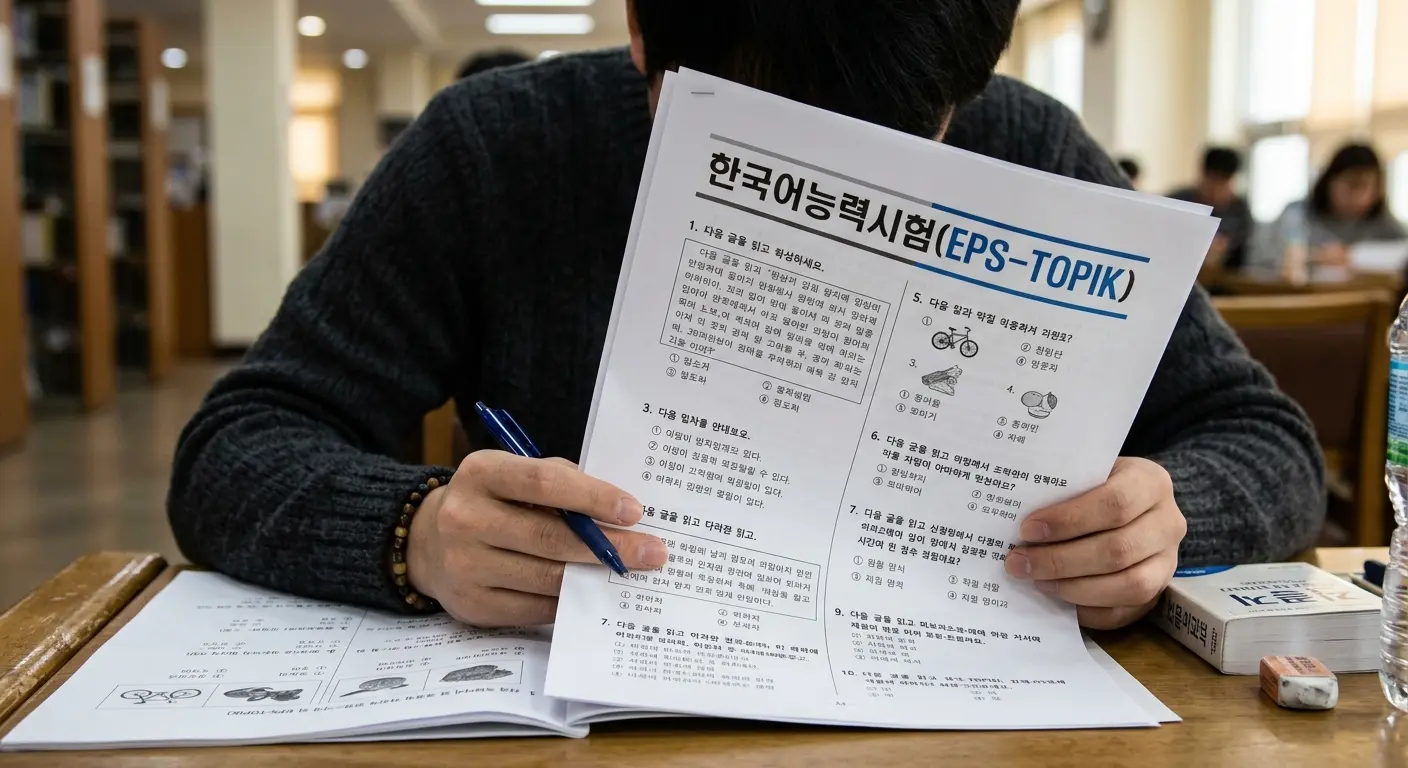
What the EPS-TOPIK Question Paper Actually Is
The EPS-TOPIK question paper isn't written by any private academy, agent, or country office. Since 2013, every question on the exam has been developed confidentially, built from the official Standard Korean Language Textbook, and the exam itself is run by Korea's own Human Resources Development Service (HRD Korea) on behalf of the Ministry of Employment and Labor. This matters for a simple reason: no consultancy or agent has access to the actual, upcoming exam questions. If anyone claims to sell "leaked" or "guaranteed" papers, they're not selling anything genuine — the real paper is drawn from a closed bank that only HRD Korea controls.
What candidates can legally access is HRD Korea's official open question bank, published on the EPS-TOPIK platform, which anyone preparing for the exam can study from for free. New and modified versions of these open questions are added, changed, and removed periodically, with updates always announced directly on HRD Korea's own site. These published questions won't appear on the actual test, but they follow the same patterns, format, and difficulty level the real closed-bank questions are built from.
The Current Question Paper Structure (CBT Format)
For the current Nepal EPS-TOPIK cycle, the paper is built around two sections delivered back-to-back with no break:
| Section | Questions | Marks | Time |
|---|---|---|---|
| Listening (듣기) | 20 questions | 50 marks | 25 minutes |
| Reading (읽기) | 20 questions | 50 marks | 25 minutes |
| Total | 40 questions | 100 marks | 50 minutes |
The exam runs continuously from start to finish, with no break between the two skill sections — so candidates need to be mentally prepared to shift directly from listening comprehension into reading comprehension without a pause to reset.
Delivery format: all current EPS-TOPIK rounds run as computer-based tests (CBT, 컴퓨터 기반 시험) or tablet-based tests (UBT, 태블릿 기반 시험), replacing the older pencil-and-paper (PBT) format used in earlier years. On the CBT screen, question content appears directly on screen and candidates click to select the correct answer, with a visible countdown timer and the ability to move between questions within a section — closely simulating what you'll face on the real test.
If you come across older prep material describing a paper-based format scored out of 200 marks with 50 questions per section, that reflects the exam's older PBT structure from earlier years. Korea's broader TOPIK family of tests has historically scored sections at up to 100 points each, and older EPS-TOPIK material followed a similarly heavier structure before the format was streamlined into today's 40-question CBT version. Always confirm the current format against your specific notice year rather than assuming an older PDF found online reflects today's paper — this is one of the most common sources of confusion for self-study candidates.
Where the EPS TOPIK Question Paper Actually Come From: The Standard Textbook
Every real EPS-TOPIK question — in both the closed exam bank and the published open sample bank — is built around HRD Korea's own official teaching material, the Standard Textbook for EPS-TOPIK (한국어표준교재).
The Standard Textbook is organized into 8 topics spread across 60 chapters, following the actual occupational structures migrant workers encounter, as mapped out by HRD Korea itself. It's published as two volumes (Book 1 and Book 2), and each chapter follows a consistent internal structure:
- Conversation — a sample dialogue introducing the chapter's study objective, new vocabulary, and a real daily-life or workplace situation migrant workers commonly face.
- Vocabulary and Expressions — new words and expressions presented with pictures and illustrations for easier understanding.
- Grammar — explanations of the grammar points tied to that chapter's study objective.
- Practice / Activity — exercises to review the chapter's vocabulary, expressions, and grammar, plus activities that help build authentic conversation using what was just learned.
- Information and Culture — general Korean cultural context alongside Korea's specific workplace culture.
- EPS-TOPIK practice questions — sample exam-style questions at the end of each chapter, directly modeled on the real test.
Alongside the Standard Textbook, HRD Korea also maintains a separate self-study e-book library (자가학습용 보조교재), currently available in a number of sending-country languages including English, Vietnamese, Myanmar, Sri Lankan (Sinhala), Uzbek, Lao, Thai, Bangladeshi, and Cambodian — both resources are free to download from HRD Korea's own EPS-TOPIK platform. There's no legitimate reason to pay a third party for these core materials; they're published free by the exam's own administering body.
Section 1: Listening (듣기) — What It Actually Tests
The listening section is where a large share of candidates lose marks unnecessarily, mostly because self-study candidates practice reading far more than they practice listening.
What the content covers: the listening section includes conversations, announcements, and short monologues, with topics that typically revolve around workplace instructions, daily life scenarios (shopping, transportation, healthcare), social interactions and greetings, and emergency or safety instructions. Candidates are tested on their ability to grasp main ideas, pick out specific details, and make reasonable inferences from context.
Question style: based on the official open question bank and the Standard Textbook's practice format, listening items typically ask candidates to:
- Identify what was said or requested in a short audio clip
- Choose the correct picture or response matching a spoken instruction
- Answer a factual detail question from a short workplace announcement
- Infer the speaker's intent, next action, or relationship from a brief dialogue
Difficulty progression: questions are designed to gradually increase in difficulty as the section progresses, simulating a natural build-up rather than front-loading the hardest content.
A practical listening quirk worth knowing: Korean pronunciation frequently diverges from how words are written, because of sound-change rules that affect how natural, fast speech actually sounds. Four patterns matter most for listening accuracy: liaison (연음 법칙, where a syllable-final consonant shifts sound into a following vowel), nasalization (비음화, where certain consonants shift sound before ㄴ or ㅁ), aspiration (격음화, where plain consonants merge with ㅎ into aspirated sounds), and tensification (경음화, where plain consonants become "tense" doubled sounds). Candidates who only study written Hangul without listening practice are often surprised by how different real spoken audio sounds from what they expected on the page — which is exactly why dedicated listening practice, not just vocabulary memorization, matters so much for this section.
Section 2: Reading (읽기) — What It Actually Tests
What the content covers: the reading section is built around short passages, compound sentences, and fill-in-the-blank exercises, requiring candidates to accurately read and analyze texts, dialogues, or short pieces of workplace or daily-life information in Korean. Test takers need to catch main ideas, pick out specific details, and make correct inferences based on context — all within a tight time limit that demands reading and analyzing simultaneously.
Question style, drawn from the Standard Textbook's practice structure and the official open question bank:
- Sentence/dialogue completion — filling a blank in a short conversation with the grammatically and contextually correct word or phrase
- Picture-based comprehension — completing a conversation based on an illustrated scenario, then forming or selecting the correct follow-up sentence
- Short passage comprehension — reading a brief notice, announcement, or workplace memo (for example, a company dinner notice or a safety instruction) and answering a factual or inferential question about it
- Compound sentence logic — choosing the correct connector or clause to link two related ideas coherently
Test-taking mechanics that matter: a useful approach is to read the question first, underline the key words, and only then read the passage to locate the relevant information — reading passages cold and then re-reading them after seeing the question wastes time you don't have in a 25-minute window.
A Realistic, Illustrative Example
To make the format concrete, here's the general shape a reading item takes:
A short notice is shown: a company announces a team dinner, giving a date, time, and location. The question asks: "Where will the team dinner be held?" with four short answer options — only one matching the location stated in the notice.
And a typical listening item follows a similar logic:
A short spoken exchange plays: a supervisor tells a worker to finish a task before lunch. The question asks what the worker was instructed to do, with four picture or short-text options to choose from.
This is the level of everyday, practical Korean the exam actually tests — not literary or academic language, and not complex grammar for its own sake. It's built around whether you can function safely and communicate clearly in a Korean workplace and in daily life around it.
The Open EPS TOPIK Question Paper Bank: A Genuinely Useful (and Free) Practice Resource
HRD Korea maintains a substantial open question bank covering both listening and reading, which any candidate can access for free through the official EPS-TOPIK platform, complete with listening audio files so candidates can self-study at home. This bank is periodically updated — questions are added, modified, or removed roughly every couple of years, with changes always announced through HRD Korea's own channels rather than third-party sites.
A word of caution on numbers here: various unofficial study sites cite different totals for how many questions sit in this open bank, and these figures shift as HRD Korea updates the bank over time. Rather than anchoring your prep around a specific headline number from an unofficial source, treat the open bank as what it actually is — a large, representative, continuously refreshed sample of the real question style, worth working through broadly rather than obsessing over an exact total.
It's worth repeating the core caveat directly: these open sample questions are a learning resource only and will not appear verbatim on the actual test. The real exam draws from a separate, closed bank built on the same patterns. Studying the open bank builds the right instincts; it isn't a shortcut to memorizing the actual paper.
How Scoring and Ranking Actually Work
Passing the question paper is necessary, but it's worth understanding what a pass actually does for you in the wider EPS process. A pass moves you toward the sector-specific skill test and eventual entry onto HRD Korea's central worker roster — it does not, by itself, guarantee an employer selects you. Because candidates on the roster are effectively ranked and browsed by potential employers, a comfortable pass with room to spare is a meaningfully stronger position than barely clearing the minimum threshold, particularly in cycles where sector quotas are tight and competition for employer selection is higher.
This is one of the most practically important things to internalize about the question paper: your goal on exam day isn't just to pass — it's to answer as many of the 40 questions correctly as your preparation allows, since a stronger score genuinely affects how competitive your roster position is afterward.
Common Mistakes Candidates Make With the Question Paper
Pulling together patterns that show up repeatedly across candidate experiences and preparation guides:
- Studying reading far more than listening. Since both sections carry equal weight (50 marks each), neglecting listening practice caps your maximum possible score just as much as neglecting reading would.
- Practicing only from old, outdated PDFs. A meaningful amount of freely circulating "model question" material online reflects the older PBT format, not the current CBT structure — practicing an unfamiliar format under exam pressure costs valuable time.
- Skipping the Standard Textbook's chapter-end practice questions. These are built directly by the exam's own official source material and mirror real question logic far more closely than random third-party PDFs.
- Ignoring pronunciation-change rules. As covered above, listening comprehension breaks down quickly if you've only studied written Hangul without exposure to how liaison, nasalization, aspiration, and tensification actually sound in natural speech.
- Not practicing under real time pressure. With just 25 minutes for 20 questions per section, candidates who've never timed themselves often run out of time on the reading section specifically, since passage-reading takes longer under pressure than casual practice suggests.
- Assuming the open question bank is the real exam. As covered above, these are official — but explicitly non-appearing — practice items. Treat them as pattern training, not memorization targets.
How to Prepare for the Question Paper Effectively
Based on the exam's actual structure and content sources described above, a genuinely effective preparation sequence looks like this:
- Start with the Standard Textbook, both volumes, working through the 8 topics and 60 chapters in order rather than jumping around — the chapters build vocabulary and grammar progressively.
- Treat listening and reading as two separate skills requiring separate practice time, not one combined "Korean study" block.
- Use the official open question bank regularly, ideally timed, to get used to the CBT interface, the pacing, and the question style.
- Study the four core pronunciation-change rules deliberately, since they affect how much of the listening section you can actually follow in real time.
- Take full, timed mock exams close to your actual test date, replicating the 50-minute, no-break format exactly, so exam-day pacing doesn't come as a surprise.
- Focus vocabulary study on workplace and daily-life terms specific to your target sector — manufacturing, agriculture, service, or forestry vocabulary genuinely differs, and the exam draws content from real occupational structures tied to these sectors.
Why Structured Classes Help With This Specific Exam
Self-study from the free official materials genuinely works — plenty of candidates pass this way. But because the paper is short (just 50 minutes), unforgiving on time, and equally weighted between two very different skills, candidates often benefit from structured classroom pacing: timed mock CBT sessions, corrected listening drills, and guided walk-throughs of exactly where marks are commonly lost.
This is the specific gap Toddle, based on School Road, Hetauda-4, Makawanpur, addresses through its EPS-TOPIK Korean language class — built around the real CBT format, sector-relevant vocabulary, and dedicated listening practice rather than reading-only self-study. The class is led by founder Madhab Sapkota, a TOPIK Level 6 holder and certified Korean language instructor. As with all EPS-TOPIK preparation, it's worth being clear about scope: this is language and exam preparation, not job placement — the roster and employer-selection process runs exclusively through Nepal's Department of Foreign Employment and HRD Korea, and no private class or consultancy can place you in an EPS job. What structured preparation can genuinely do is put you in the strongest possible position to walk into that 50-minute paper and score well on your first attempt.
Frequently Asked Questions about EPS TOPIK Question Paper
1. How many questions are on the EPS-TOPIK question paper?
40 total — 20 listening questions and 20 reading questions.
2. How many marks is the exam out of?
100 marks total, split 50/50 between the listening and reading sections.
3. How much time do I get for each section?
25 minutes for listening and 25 minutes for reading, run continuously with no break between the two sections.
4. Is the exam computer-based or paper-based?
Current EPS-TOPIK rounds run as computer-based tests (CBT) or tablet-based tests (UBT) — the older pencil-and-paper format has been phased out.
5. What topics does the listening section cover?
Workplace instructions, daily life scenarios like shopping, transportation, and healthcare, social interactions and greetings, and emergency or safety instructions.
6. What kind of questions appear in the reading section?
Short passages, compound sentences, and fill-in-the-blank exercises testing comprehension, detail recognition, and inference.
7. Where do the actual exam questions come from?
They're developed confidentially, based on the official Standard Korean Language Textbook, by HRD Korea itself.
8. Can I get real past exam questions to practice with?
Not exactly — HRD Korea's official sample questions are explicitly a learning resource that won't appear on the actual test, though they closely mirror the real question style and difficulty.
9. Is the Standard Textbook free?
Yes — both the Standard Textbook and the supplementary self-study e-book library are free to download from HRD Korea's official EPS-TOPIK platform.
10. How is the Standard Textbook organized?
Into 8 topics across 60 chapters, following real occupational structures for migrant workers, published as two volumes.
11. Do listening and reading carry equal weight in scoring?
Yes — each section is worth 50 of the 100 total marks.
12. Why does the exam feel harder in real speech than in textbook Korean?
Because natural Korean speech follows pronunciation-change rules — liaison, nasalization, aspiration, and tensification — that shift how words sound compared to how they're written.
13. Can a private agency give me the actual upcoming exam questions?
No — the real closed question bank is confidential and controlled entirely by HRD Korea; no private party has legitimate access to it.
14. What language level does the paper actually test?
Practical, everyday Korean for work and daily life — not academic or literary Korean, and not the more advanced vocabulary tested by the general academic TOPIK exam.
15. Does the format ever change?
Yes — HRD Korea periodically updates the question bank and has moved the exam from an older paper-based format to the current CBT/UBT structure, so it's worth confirming the current format against your specific application-round notice rather than older material.
16. Should I focus more on listening or reading if I'm short on time?
Neither should be skipped — since they're equally weighted, a strong reading score can't fully compensate for a weak listening score, and vice versa.
17. Is there a break between the listening and reading sections?
No — the exam runs continuously from start to finish.
Conclusion: Prepare for the Paper You'll Actually Sit
The EPS-TOPIK question paper isn't designed to trip candidates up with obscure vocabulary or academic Korean — it's built directly from real workplace and daily-life scenarios, drawn from HRD Korea's own official Standard Textbook. That's genuinely good news for candidates: the material to prepare with is free, official, and clearly structured around exactly what the exam tests.
The candidates who struggle usually aren't the ones who lack ability — they're the ones who practiced the wrong format, leaned too heavily on reading while neglecting listening, or never sat a single full 50-minute mock exam before test day. Get the structure right — 40 questions, 50/50 between listening and reading, 50 minutes, no break — and build your preparation directly around it, and the paper stops being a mystery and starts being something you can walk into with a real, practiced strategy.