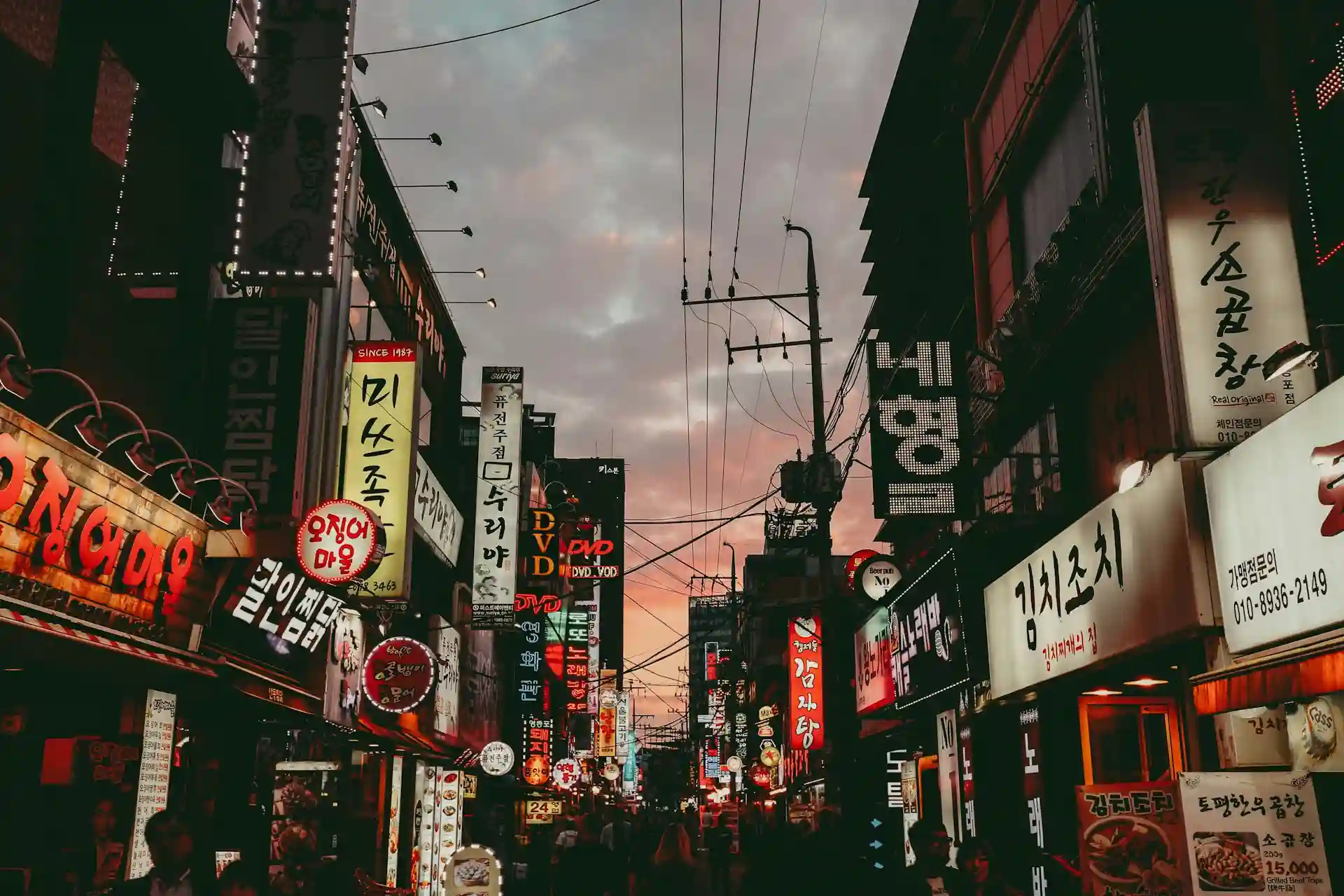
Introduction to Korea Study Visa
Choosing the wrong student visa category is one of the most common — and most costly — mistakes Nepali applicants make when planning to study in South Korea. It sounds like a small administrative detail, but applying for the wrong visa code can delay an admission by months, force a student to leave Korea and reapply from Nepal, or create complications at the Alien Registration stage after arrival.
Korea remains a major global study destination, having hosted roughly 253,434 international students in 2025, with the government actively working toward its "Study Korea 300K" target of 300,000 international students by 2027. For that growing pipeline of students, everything genuinely starts with getting the visa category right — and Korea's system is built around two core categories for students: the D-4 language-training visa and the D-2 degree-program visa.
This Korea Study Visa guide walks through both in full detail — subcategories, documents, fees, financial requirements, work rights, and what happens after you land — so you apply for the right one the first time.
D-2 vs. D-4 vs. D-10: The Quick Decision Table
| Feature | D-4 (Language Training) | D-2 (Degree Program) | D-10 (Post-Graduation Job Seeking) |
|---|---|---|---|
| Purpose | Korean-language study at a university-affiliated institute | Bachelor's, master's, or PhD study | Job hunting in Korea after finishing a degree |
| Do you need admission to a degree program? | No | Yes | N/A — issued after graduation |
| Can you work part-time immediately? | No — generally a waiting period applies | Yes, once part-time work permission is granted | Limited, permit-dependent |
| Typical academic entry requirement | Completed +2/high school or equivalent | Completed +2 (undergraduate) or bachelor's (postgraduate) | Completed degree |
| Leads to | Conversion to D-2 once you gain admission and meet language requirements | D-10 after graduation, then E-7/F-2 work and residency tracks | E-7 (work visa) or other status upon securing employment |
If you already have direct admission into a degree program and meet the language or English-test requirement, apply for D-2 — there's no reason to go through D-4 first. If you don't yet have direct admission or need to build your Korean proficiency, D-4 is the standard entry point.
Understanding the D-4 Visa: Subcategories and Purpose
The D-4 visa category covers non-degree training programs, and it's split into several distinct subcodes, each for a different purpose:
| Code | Purpose |
|---|---|
| D-4-1 | Korean Language Trainee — for applicants with at least a high school diploma or equivalent studying Korean at a university-affiliated language institute |
| D-4-2 | General Trainee (Others) |
| D-4-3 | Elementary/Middle/High School Student |
| D-4-5 | Trainee Chef (Korean cuisine training) |
| D-4-6 | General Trainee at a private academic institute with recognized, outstanding performance |
| D-4-7 | Foreign Language Trainee |
For the overwhelming majority of Nepali students, D-4-1 is the relevant code — issued for enrollment in a Korean-language program at a university-affiliated language institute, with no prior Korean-language ability required to apply. This is the standard route for students who don't yet have direct degree admission or haven't yet reached the language proficiency their target program requires.
Important: a D-4 visa does not permit you to study a degree program. If you're admitted to a university's Korean language institute on a D-4, but later gain admission to that university's actual bachelor's or master's program, you are required to convert to a D-2 visa before beginning the degree program — continuing to study on a D-4 status while enrolled in a degree track is a visa violation.
Understanding the D-2 Visa: Subcategories and Purpose
The D-2 visa is the actual degree-program visa, and it's divided into eight official subcategories:
| Code | Purpose |
|---|---|
| D-2-1 | Associate Degree (junior college) |
| D-2-2 | Bachelor's Degree (undergraduate) |
| D-2-3 | Master's Degree |
| D-2-4 | Doctoral Degree |
| D-2-5 | Research Study |
| D-2-6 | Exchange Student |
| D-2-7 | Student Invited by the Korean Government (this covers Global Korea Scholarship/GKS recipients) |
| D-2-8 | Short-Term Study |
A student admitted to a standard bachelor's program applies for D-2-2; a master's or PhD candidate applies for D-2-3 or D-2-4 respectively. Students specifically funded through the Global Korea Scholarship apply under D-2-7, regardless of whether their program is undergraduate or graduate level — and GKS recipients typically benefit from simplified or reduced financial documentation requirements, since the scholarship itself already demonstrates funded status.
Certified vs. Non-Certified Universities: Why It Matters for Your Visa
Not every Korean university is treated identically by immigration authorities when it comes to visa processing. Korea maintains a system of certified universities (인증대학) — institutions recognized for maintaining low visa-violation rates among their international students — which benefit from simplified D-2 visa screening for their admitted students, and whose students often qualify for enhanced part-time work hour allowances compared to students at non-certified institutions.
Non-certified universities can still sponsor D-2 visas for their international students, but applicants should expect a fuller, more detailed document review.
Practical implication: when comparing university offers, it's worth asking directly whether your target university holds current certified status, since this can meaningfully affect both how smoothly your visa application goes and how many hours you're permitted to work part-time later.
Eligibility and Academic Requirements
| Visa | Minimum Academic Requirement |
|---|---|
| D-4-1 (Language Training) | At least completed +2 (Higher Secondary Education) or equivalent |
| D-2-1/D-2-2 (Associate/Bachelor's) | Completed +2 / National Examination Board Higher Secondary Certificate or internationally recognized equivalent |
| D-2-3/D-2-4 (Master's/PhD) | Completed bachelor's degree to a satisfactory academic standard |
| D-2-6 (Exchange) | Current enrollment at a home-country university with an active exchange agreement |
Beyond the base academic requirement, most degree programs at Korean universities also expect either a Korean-language proficiency benchmark (commonly TOPIK Level 3 or above) or an equivalent English-language test score (IELTS Academic around 5.5–6.0, or TOEFL iBT around 71+) for English-taught programs — the specific requirement depends entirely on whether your chosen program is taught in Korean, English, or a mix of both.
The Financial Requirement: What You Actually Need to Show
This is one of the most scrutinized parts of any Korea student visa application, and it's worth understanding precisely rather than treating it as a rough formality.
- Commonly cited benchmark: a bank balance of approximately KRW 20,000,000 (roughly USD 15,000), which needs to have been held in the account for a minimum period — commonly cited as at least 28 days — before the visa application, rather than deposited immediately beforehand.
- Broader range across sources: depending on the specific program, its cost, and duration, total financial proof requirements for Nepali applicants are commonly described in the range of roughly NPR 8–20 lakh, correlating with the D-4 (generally lower) versus D-2 (generally higher) distinction.
- GKS-funded students (D-2-7): financial documentation requirements are often significantly reduced or waived, since the scholarship itself already demonstrates the student's funding is secured.
- Account history matters as much as the total: embassies and universities alike tend to scrutinize whether a balance was built up steadily over time versus deposited as a single large lump sum shortly before application — a pattern that can raise questions about whether the funds genuinely belong to the family or were borrowed temporarily to pass the financial check.
Always confirm the exact, current financial threshold for your specific visa subcategory and program directly with the Korean Embassy in Kathmandu or your target university, since exact figures are reviewed periodically and can vary by case.
Complete Document Checklist
While specific universities and embassy staff may request minor additions, the core document set for both D-4 and D-2 applications generally includes:
| Document | Notes |
|---|---|
| Valid passport | Original plus a clear photocopy; generally valid for at least 6 months beyond intended stay |
| Visa application form | Completed accurately, with a 3.5cm × 4.5cm color photo attached |
| Certificate of Admission | Issued by the Korean university or language institute |
| Academic transcripts | +2/SEE (or bachelor's, for postgraduate applicants), with certified English translation |
| Financial proof | Bank statement/certificate meeting the current threshold, showing account history, not just a snapshot balance |
| Bank statement/certificate | Sometimes issued directly by the bank as a formal certificate rather than a simple printed statement |
| Passport-size photographs | Additional copies beyond the one on the application form, as required |
| Health/medical documentation | Including a tuberculosis (TB) test certificate for applicants from specific countries, including Nepal |
| MoFA-attested documents | Academic transcripts and certain certificates generally require Ministry of Foreign Affairs attestation |
| No Objection Certificate (where applicable) | Sometimes required depending on funding source or program type |
| Proof of tuition payment | Often required once admission is confirmed, before final visa documents are issued |
All documents not already in English or Korean must be translated by a certified professional translator before submission — informal or self-translated documents are generally not accepted.
Nepal-Specific Requirements Worth Planning Around Early
Two requirements specific to Nepali applicants (and a handful of other countries) regularly catch students off guard if left until the last minute:
Tuberculosis (TB) test certificate: Nepal is among a small group of countries — alongside India, China, Vietnam, and the Philippines — for which Korean authorities specifically require a TB test certificate as part of standard D-2/D-4 visa documentation. This needs to be arranged at an approved facility, and leaving it until the final week before your visa deadline is a common, entirely avoidable source of delay.
MoFA attestation: academic transcripts (including +2 and SEE records) generally need to be translated into English, formatted with correct grading-scale documentation, and then attested by Nepal's Ministry of Foreign Affairs before submission. This step alone can take longer than students expect — building in real buffer time here, rather than assuming it's a same-day process, is one of the single most useful pieces of practical advice for any Nepali applicant.
Step-by-Step: The Visa Application Process
- Secure admission to your chosen university's degree program (for D-2) or language institute (for D-4).
- Gather and prepare all documents listed above, starting with the ones that take longest — MoFA attestation and the TB test — well in advance of your target deadline.
- Build your financial documentation over time, ensuring your bank balance reflects genuine, steady funds rather than a last-minute lump sum.
- Pay tuition (or the required deposit) once your admission is confirmed, since the university typically needs proof of payment before issuing your final Certificate of Admission or visa-supporting documents.
- Submit your visa application at the Embassy of the Republic of Korea in Kathmandu, with all required documents and fees.
- Await processing, which typically takes around 2–4 weeks once your file is complete.
- Collect your visa once approved, and confirm your entry details, including your flight and initial accommodation arrangements in Korea.
Korea Study Visa Fees and Processing Time
| Item | Typical Figure |
|---|---|
| Visa processing time (D-2 and D-4) | Roughly 2–4 weeks once documents are complete |
| Visa application fee | Varies by visa type and number of entries requested — confirm the current fee schedule directly with the Korean Embassy in Kathmandu |
| Alien Registration/Residence Card fee (after arrival) | Commonly cited around KRW 30,000, though this can vary |
Always confirm current fees directly with the embassy before applying, since fee schedules are reviewed periodically.
After You Arrive: Registering for Your Residence Card (Formerly ARC)
Getting your visa and landing in Korea isn't the final step — every student intending to stay more than 90 days is legally required to register as a foreign resident. This document, historically called the Alien Registration Card (ARC), was officially renamed the Residence Card (RC) in 2024, though many people — Korean and foreign alike — still refer to it as the ARC in everyday conversation.
| Residence Card Registration | Detail |
|---|---|
| Deadline | Within 90 days of your date of entry into Korea |
| Where | The immigration office covering your registered address in Korea |
| Core documents | Passport, visa, one recent passport-style photo (3.5cm × 4.5cm, white background, taken within the last 6 months), proof of Korean address, university enrollment certificate |
| Fee | Commonly cited around KRW 30,000 |
| Processing time | Typically a few weeks after your application is submitted |
| Fingerprints | Required as part of the application process |
| Consequence of missing the deadline | Administrative fines, and potential complications with visa status, extensions, and international travel until the card is issued |
A critical, often-overlooked detail: if you attempt to travel outside Korea before receiving your Residence Card, your visa status can be affected — some sources note that traveling before registration can result in complications with a single-entry visa specifically, since the registration is what confirms your ongoing legal residence status.
The safest approach is simple: apply for your Residence Card within your first two weeks in Korea, well ahead of the 90-day deadline, and avoid any international travel until it's issued.
And for a more detailed guide to studying and living in korea, you can also read up on our Pre-Departure Orientation Korea complete guide article (PODT).
National Health Insurance: A Mandatory Step
Once registered as a foreign resident, international students are generally required to enroll in Korea's National Health Insurance Service (NHIS) — typically arranged automatically through the university once Residence Card registration is complete. Monthly premiums are commonly cited in the range of roughly KRW 40,000 (about USD 30), and enrollment significantly reduces out-of-pocket costs for any medical care needed during your studies.
Converting From D-4 to D-2: How the Transition Actually Works
For students who start on a D-4 language-training visa, the standard path to a full degree program looks like this:
- Complete your Korean-language coursework at the university-affiliated institute.
- Reach the language proficiency benchmark required for your target degree program (commonly TOPIK Level 3 or higher, though this varies by program).
- Apply for and secure formal admission into the specific degree program.
- Submit a status-change application to convert from D-4 to the appropriate D-2 subcategory (D-2-1 through D-2-4, depending on your program level) before the start of the semester.
This conversion is a well-established, standard process — but it needs to be completed before the degree program begins, not after. Attempting to attend degree-level classes while still holding D-4 status is treated as a violation of your visa conditions.
Part-Time Work Rights by Visa and Proficiency Level
| Visa Status | Work Rights |
|---|---|
| D-4 (Language Training) | Generally requires a waiting period (commonly cited around 6 months) before part-time work permission is available, and a proper work permit is required before starting any job |
| D-2 (Bachelor's) | Commonly cited around 20 hours/week once permitted (often after an initial period and reaching a TOPIK proficiency threshold, such as Level 3) |
| D-2 (Master's/PhD) | Commonly cited around 30 hours/week under similar proficiency conditions |
| All visa holders | Unlimited work generally permitted during official vacation periods; manufacturing and construction work generally off-limits regardless of visa type |
These figures shift periodically as Korean immigration policy evolves — some more recent cycles have expanded allowable hours further.
Always confirm the current, exact hour limits with your university's international office or through Hi Korea before starting any part-time job, since working beyond your permitted hours, or without a proper permit, is treated as a visa violation regardless of intent.
Maintaining Your Korea Study Visa Status: What Universities and Immigration Actually Watch
Holding a D-2 visa isn't a one-time achievement — it requires maintaining certain academic standards throughout your program:
- Minimum GPA: many programs and visa-extension reviews expect students to maintain at least a C average (commonly cited around GPA 2.0 or above) — falling below this can trigger stricter scrutiny at your next visa extension.
- Minimum enrollment status: dropping below a required minimum course load can affect your visa standing, since your visa is directly tied to maintaining active, full-time student status.
- Timely extension applications: visa extensions generally need to be filed well before your current visa expires — waiting until the final days risks processing delays that could leave you technically out of status.
After Graduation: D-2 to D-10 and Beyond
Completing your degree doesn't automatically end your time in Korea if you want to stay and work. The standard progression looks like this:
- D-10 (Job Seeking visa): graduates typically transition into this status, giving them time to search for employment in Korea before securing a formal work visa.
- E-7 (Professional/Skilled Work visa): once a graduate secures a qualifying job offer, they typically move into an E-7 visa (or another relevant work category), covering most office-track professional employment in Korea.
- F-2 (Long-Term Residency): after accumulating sufficient points across factors like education, income, Korean-language proficiency, and age (commonly requiring 80+ points under the F-2-7 points-based track), long-term visa holders may become eligible for F-2 residency.
- K-STAR Program: a newer track introduced in 2026 specifically allows qualifying STEM graduates on D-2 visas to transition directly to F-2 residency through a university recommendation, bypassing the standard E-visa step entirely — a notable option for science and technology graduates, worth researching further if it applies to your field.
Common Reasons Visa Applications Get Refused
- Financial documentation that looks manufactured — a large balance appearing shortly before the application rather than built up over months.
- Incomplete or improperly attested academic documents — missing MoFA attestation, incorrect grading-scale translation, or mismatched names across documents.
- Missing or delayed TB test certification for Nepali applicants specifically.
- Applying for the wrong visa subcategory — for instance, applying for D-2 without having actual degree-program admission, or continuing on D-4 status after gaining degree admission.
- Inconsistent information across documents — differences in name spelling, date of birth, or other personal details between your passport, citizenship documents, and university paperwork.
- Choosing a university or program with visa-issuance concerns — a small number of institutions have, in past cycles, faced restrictions on their ability to sponsor visas due to prior compliance issues; confirming a university's current standing is a reasonable precaution.
Common Mistakes Applicants Make
- Assuming D-4 and D-2 are interchangeable — they serve genuinely different purposes, and confusing them wastes both time and money.
- Leaving MoFA attestation until the final weeks before the application deadline.
- Depositing a large lump sum right before applying, rather than building genuine financial history over months.
- Not confirming a university's certified status, missing out on simplified processing and enhanced work-hour eligibility.
- Missing the 90-day Residence Card registration deadline after arrival, risking fines and status complications.
- Working part-time without a proper permit, or beyond permitted hours, even briefly.
- Letting GPA or enrollment status slide, jeopardizing a future visa extension.
- Traveling internationally before Residence Card registration is complete, risking visa complications.
How Local Guidance Helps Navigate This Process
Given how many interlocking pieces this process involves — visa subcategory selection, financial documentation timing, MoFA attestation, the TB test, and the eventual D-4-to-D-2 conversion or post-graduation transitions — many Nepali applicants benefit from structured counseling rather than navigating it entirely alone for the first time.
Toddle, based in Hetauda, Makawanpur, provides D-2, D-2 code, and D-4-1 code student visa counseling specifically for Nepali applicants, alongside its Korean-language and TOPIK preparation classes. Having guidance grounded in the actual visa mechanics — not just general encouragement — can meaningfully reduce the kind of avoidable delays (a missed attestation deadline, a poorly timed bank deposit, an incorrect subcategory) that otherwise turn a straightforward application into a months-long setback.
Frequently Asked Questions about Korea Study Visa
1. What's the core difference between D-2 and D-4?
D-2 is the actual degree-program visa (bachelor's, master's, PhD); D-4 is a language-training visa for students without direct degree admission or the required language proficiency yet.
2. Do I need to know Korean to get a D-4 visa?
No — D-4-1 specifically requires no prior Korean-language ability to enroll in a university-affiliated language program.
3. How many subcategories does the D-2 visa have?
Eight: D-2-1 (Associate), D-2-2 (Bachelor's), D-2-3 (Master's), D-2-4 (Doctoral), D-2-5 (Research), D-2-6 (Exchange), D-2-7 (Government-sponsored/GKS), and D-2-8 (Short-Term Study).
4. How much money do I need to show for a Korea student visa?
Commonly cited around KRW 20,000,000 (roughly USD 15,000), held for at least 28 days before applying — though the exact requirement varies by program and visa subcategory, so always confirm current figures.
5. Are GKS scholarship recipients required to show the same financial proof?
No — GKS-funded students (D-2-7) often have financial documentation requirements significantly reduced or waived, since the scholarship already confirms funding.
6. Why do Nepali applicants specifically need a TB test?
Nepal is one of several countries — alongside India, China, Vietnam, and the Philippines — for which Korean authorities specifically require tuberculosis testing as part of standard visa documentation.
7. How long does Korea study visa processing typically take?
Around 2–4 weeks once your complete application is submitted at the Embassy of the Republic of Korea in Kathmandu.
8. What happens if I don't register for my Residence Card within 90 days?
You risk administrative fines and potential complications with your visa status, future extensions, and international travel.
9. Can I work part-time on a D-4 visa?
Generally only after a waiting period (commonly cited around 6 months) and with a proper work permit — working without a permit is treated as illegal employment regardless of visa type.
10. How do I convert from D-4 to D-2?
Complete your language coursework, reach the required proficiency level, gain formal admission to your target degree program, and submit a status-change application before the semester begins.
11. What GPA do I need to maintain my D-2 status?
Commonly cited around a 2.0 (C average) or above — falling below this can trigger stricter scrutiny at your visa extension.
12. What visa do I get after finishing my degree in Korea?
Most graduates transition to a D-10 job-seeking visa, then to E-7 (or another relevant work visa) once they secure employment, with F-2 long-term residency potentially available later.
13. What is a "certified university," and does it matter?
It's a Korean university recognized for low visa-violation rates among its international students, benefiting from simplified D-2 visa screening and often enhanced part-time work hour allowances — worth checking when comparing university offers.
14. Do all Korean universities require MoFA attestation of my transcripts?
Generally yes, for Nepali applicants — academic transcripts typically need certified English translation and Ministry of Foreign Affairs attestation before submission.
15. What's the biggest visa-related mistake Nepali students make?
Depositing a large, sudden lump sum into their bank account right before applying rather than building genuine financial history over months — this is one of the most common reasons financial documentation draws additional scrutiny.
16. Is there a faster path to long-term residency for STEM graduates?
Yes — the K-STAR program, introduced in 2026, allows qualifying STEM students on D-2 visas to transition directly to F-2 residency through a university recommendation, bypassing the standard E-visa step.
17. Can I travel outside Korea before I get my Residence Card?
This is best avoided — traveling before your Residence Card is issued can create complications with your visa status, so most guidance recommends waiting until the card is in hand.
Conclusion: The Korea Study Visa Is a Process, Not a Single Form
Getting a Korea study visa right isn't about filling out one form correctly — it's about sequencing a series of interlocking steps correctly: choosing the right subcategory for your actual academic situation, building genuine financial documentation over months rather than days, starting MoFA attestation and your TB test early, and understanding exactly what happens after your visa is approved — the Residence Card deadline, health insurance enrollment, and the eventual D-4-to-D-2 conversion if that applies to you.
Students who treat this as a single event — "get the visa, then figure out the rest" — are consistently the ones who run into avoidable delays and complications. Students who treat it as a connected sequence, with each step properly timed and documented, are the ones who land in Korea with a status that's genuinely secure from day one.
Get the sequence right, and the visa stops being the obstacle standing between you and Korea — it becomes simply the first completed step in a much longer, and much more exciting, journey, and if you are confused about anything, you can check our guide on Pre-Departure Orientation Korea article.