Study in Korea from Nepal
Every year, thousands of Nepali students start Googling some version of "study in Korea from Nepal" — usually after a friend, a cousin, or someone from the same tole posts photos from Seoul or Busan. What they find next is a maze: five different visa codes, contradictory bank balance figures, scholarship names that sound identical, and consultancies that all claim to be "the best in Nepal." Very little of it is written for someone sitting in Hetauda, Makawanpur, or a village two hours from the nearest embassy-approved bank branch, trying to figure out whether they even qualify.
This guide is written to close that gap. It walks through the real visa categories (D-4 and D-2), the actual document and financial requirements Nepali applicants face at the Korean Embassy in Kathmandu, how the Global Korea Scholarship (GKS) genuinely works for Nepali citizens, what TOPIK has to do with your future income in Korea, and where students most often go wrong — not in theory, but in practice.
Why Korea, Specifically, for a Nepali Student
Before the "how," it's worth being honest about the "why," because Korea isn't the right fit for every student, and pretending otherwise does no one a favor.
Korea appeals to Nepali students for a fairly specific combination of reasons: tuition and living costs that sit meaningfully below the UK, US, or Australia; a fast, well-organized visa and university system once your documents are in order; a labor market that actively wants graduates with technical, engineering, and language skills; and a cultural pull — K-drama, K-pop, Korean food — that genuinely makes the adjustment easier for a lot of students compared to a colder, more anonymous Western campus. Part-time work opportunities of up to roughly 20 hours a week and strong scholarship programs, including GKS and university-level awards, are also part of the draw for Nepali applicants.
What it is not: a shortcut, a guaranteed path to permanent residency, or a place where you can get by without any Korean language at all past your first year. Students who go in expecting an easy ride are the ones who end up frustrated by the second semester.
D-4 vs D-2: Understanding the Two Visa Tracks
This is the single most misunderstood part of the entire process, and it's worth getting right before anything else.
A D-4 visa does not let you study your actual degree program at a university — it exists purely for language or preliminary training. Most Nepali students who don't yet have strong Korean skills or a direct degree offer start here: it's issued for enrollment in Korean language programs at university-affiliated language institutes, and no prior Korean knowledge is required to apply. After roughly a year of language study — and usually once you reach a workable TOPIK level — you apply to convert into a D-2 for your actual bachelor's, master's, or PhD program. This D-4-first, D-2-later route is common enough that it's often described as the standard pathway for students who haven't yet met a university's direct-admission language bar.
The D-2 is the actual degree visa, and it isn't one single category — it splits into subcodes: D-2-1 for junior college, D-2-2 for undergraduate degrees, D-2-3 for graduate school, D-2-4 for general graduate programs, D-2-5 for research training, and D-2-6 for industrial cooperation courses.
| Feature | D-4 (Language Training) | D-2 (Degree Program) |
|---|---|---|
| Purpose | Korean language study at a university-affiliated institute | Bachelor's, master's, or PhD degree |
| Prior Korean required | No | Program-dependent; often TOPIK 3+ preferred |
| Minimum academic entry | At least +2 or equivalent | Completed +2 for undergraduate; completed bachelor's for postgraduate |
| Typical language proof | Generally not required upfront, though some universities ask for IELTS 5.0+ | IELTS Academic roughly 5.5–6.0, TOEFL iBT 71+, or TOPIK depending on the institution |
| Typical processing time | Around 2–4 weeks once documents are complete | Around 2–4 weeks once documents are complete |
| Can lead to | A follow-on D-2 application | Direct route toward D-10 job-seeking visa after graduation |
If you take one thing from this section: don't let anyone sell you a D-4 as "basically the same as a degree visa." It is a language program, full stop. It's a genuinely useful and often necessary first step — but it's a step, not the destination.
Eligibility and the Financial Requirement Nepali Students Underestimate
The Korean Embassy in Kathmandu applies the same broad framework to every applicant, but Nepal has its own added layer that catches a lot of students off guard.
Academic eligibility. A bachelor's degree completed to a satisfactory standard is required for postgraduate D-2 study, while a National Examination Board (+2) Higher Secondary Education Certificate or an internationally recognized equivalent is required for undergraduate D-2 admission.
Financial proof. This is where most rejections quietly happen, because students treat the bank balance as a formality rather than something the embassy actually scrutinizes. D-4 applicants are generally expected to show roughly NPR 8–15 lakh, while D-2 applicants should be able to show around NPR 12–20 lakh or more, depending on the program's length and cost. It isn't only the total balance that matters — the embassy also looks at account history, comparing steady deposits against sudden large lump-sum transfers, because a balance that appeared two weeks before the interview reads very differently from one built up over months.
The health requirement specific to Nepal. Nepal is one of a handful of countries — alongside India, China, Vietnam, and the Philippines — required to submit a tuberculosis test certificate as part of the standard D-2 visa documentation. Students who don't plan for this early often lose a week or two scrambling to get the test done at an approved facility right before their deadline.
Document attestation. Academic transcripts, including +2 and SEE records, generally need English translations, correct grading-scale documentation, and Ministry of Foreign Affairs (MoFA) attestation. This single step — MoFA attestation — is where timelines quietly blow up for students who assume it takes a day. Build in real buffer time here.
TOPIK: Why It Matters More Than Most Students Think
TOPIK (Test of Proficiency in Korean) isn't just an admissions checkbox. It follows you into your work rights, your scholarship eligibility, and eventually your long-term visa status in Korea.
For admission purposes, TOPIK Level 3 is generally treated as the minimum for degree programs, with Level 4 or above preferred by most universities. But TOPIK's real weight shows up later: your Korean proficiency level is one of the main factors immigration uses to decide how many hours a week you're allowed to work part-time, and it becomes a genuine scoring factor if you eventually apply for a longer-term residency track after graduation. Students planning to stay in Korea long-term after graduation are generally advised to start TOPIK preparation from their first semester rather than their final year, since it directly affects both part-time work hour limits and future residency point calculations.
The practical takeaway: treat TOPIK as a skill you're building for four years, not an exam you cram for once.
The Global Korea Scholarship (GKS): What Nepali Students Actually Qualify For
GKS — still commonly called KGSP by older guides and by many Nepali students — is the single most valuable funding route available, and it's worth understanding properly rather than through secondhand rumor.
- Eligibility. Applicants generally need to be under 40 years old, hold a GPA above roughly 2.64 on a 4.0 scale (or around 80% on a percentage scale), and be a citizen of a country with diplomatic ties to Korea — Nepal qualifies. Neither the applicant nor their parents can hold Korean citizenship or dual citizenship including Korea.
- What it actually covers. A full tuition waiver, a monthly living stipend (recent cycles have set this at roughly KRW 900,000 for undergraduates and KRW 1,000,000 for graduate students), round-trip economy airfare, a full year of Korean language training, a settlement allowance, and medical insurance. More recent GKS cycles have restructured how the money is delivered — several previously separate allowances (settlement, insurance, TOPIK incentive, completion grant) have been folded into one larger monthly allowance rather than paid out as separate line items.
- How Nepali applicants apply. There are two tracks: the Embassy Track, applied for directly through the Korean Embassy in Kathmandu, and the University Track, applied for directly through the chosen Korean university. The Embassy Track tends to be more competitive but opens up more university choices. A genuinely useful thing about applying from Nepal is that Embassy Track applicants compete only against other Nepali applicants for Nepal's designated seats, not against the entire global applicant pool.
- How limited the seats actually are. This is the part most blog posts gloss over, and it matters for setting realistic expectations. For the undergraduate GKS track, the Embassy Track for Nepal has typically offered around 2 seats (1 General, 1 R-GKS). For the graduate GKS track, Nepal's Embassy Track allocation has typically been around 4 seats. That's not a reason to avoid applying — it's a reason to build a strong backup plan (self-funded D-4/D-2 route or a university-specific scholarship) alongside your GKS application, rather than treating GKS as your only option.
| GKS Fact | Detail |
|---|---|
| Age limit | Under 40 years old |
| Minimum academic bar | GPA ~2.64/4.0 or ~80% equivalent |
| Covers | Tuition, monthly stipend, airfare, 1-year language training, settlement allowance, medical insurance |
| Application routes | Embassy Track or University Track |
| Nepal undergraduate seats (Embassy Track) | ~2 (General 1, R-GKS 1) |
| Nepal graduate seats (Embassy Track) | ~4 |
| Program length | 1 year Korean language + 2 years Master's / 3 years Doctoral (graduate track) |
Beyond GKS, Nepali students are also eligible for other government and institutional funding. This includes the KOICA Scholarship and university-specific scholarships at institutions like Seoul National University, KAIST, POSTECH, Yonsei, and UST. If GKS doesn't work out in your first attempt, these are worth exploring rather than treating the door as closed.
Real Cost of Studying and Living in Korea
Numbers here vary by city and lifestyle, but a rough, honest baseline helps with planning. Monthly living costs in Seoul — excluding tuition — generally run somewhere between roughly ₩1.2 million and ₩1.5 million (about USD 900–1,150), which covers housing, food, transport, and basic expenses. Cities outside Seoul — Busan, Daegu, Gwangju — tend to run noticeably cheaper on housing in particular, which is one reason many Nepali students end up choosing universities outside the capital.
This is also exactly why the embassy's financial-proof requirement exists: a family covering NPR 8–20 lakh upfront needs a realistic sense of ongoing costs, not just the number needed to clear the visa interview.
Part-Time Work: What's Actually Allowed
This is an area where rules genuinely shift year to year, and where outdated blog posts cause real problems — so treat the specific hour numbers below as a general framework to confirm with your university's international office or Hi Korea before you accept any job, not as fixed law.
The core principle stays consistent across recent years: international students in South Korea can work part-time, but a legally issued part-time work permit is required before starting any job, and working without one risks visa cancellation. D-2 visa holders in particular must obtain this permit before beginning any part-time work — working without it can be treated as illegal employment and can affect future visa extensions.
Allowed weekly hours are generally tied directly to Korean proficiency: students below TOPIK Level 3 have typically faced a lower weekly cap, while students with TOPIK Level 3 or higher have generally been allowed noticeably more hours per week, with further increases available at TOPIK Level 4. Some more recent 2026 policy updates have expanded allowable part-time hours further to help ease students' financial burden, alongside unlimited work during official vacation periods.
A few things stay constant regardless of the exact hour cap in force: manufacturing and construction work are generally off-limits to student visa holders, the permit is usually tied to one specific employer and workplace, and changing jobs means reapplying rather than simply carrying the old permit over. South Korea's minimum wage applies to international students exactly as it does to Korean workers — there are no legal exceptions for visa status.
The Step-by-Step Reality of Applying
- Decide your route first. Do you have a direct degree offer and the required English/Korean scores, or do you need a year of language study first? This decision shapes everything downstream.
- Shortlist universities honestly. Match your GPA, budget, and target field to realistic options — not just the five names every consultancy pitches.
- Gather and attest documents early. This includes your +2 and SEE transcripts with English translations, grading-scale documentation, and MoFA-attested certificates. Start this months, not weeks, before your deadline.
- Secure your admission offer, then arrange your No Objection Certificate and tuition transfer, since the university generally needs proof of payment before issuing final visa paperwork.
- Complete your TB test and medical documentation — non-negotiable for Nepali applicants.
- Build and document your financial proof over time, not in a single last-minute deposit.
- Submit your visa application at the Embassy of the Republic of Korea in Kathmandu , where processing typically takes about 2–4 weeks once your file is complete.
- Prepare for departure — housing, orientation, and, ideally, basic conversational Korean before you land.
Where Nepali Applications Actually Fail
Having read through what causes rejections and delays across current guidance, the pattern is consistent:
- Financial proof that looks manufactured — a lump sum appearing right before the interview, rather than a balance built up over months.
- Skipping MoFA attestation timelines and running out of runway before the deadline.
- Treating the D-4 as a backdoor into a degree program rather than what it actually is — a language track.
- Zero TOPIK preparation until after arrival, which limits both work rights and long-term settlement options later.
- Choosing a university based only on rankings or a consultancy's commission incentive, without checking whether that university is currently in good standing with Korean immigration for visa issuance. Confirming a university's current certification status matters, since a small number of universities have lost visa-issuing eligibility in recent cycles.
Life After Graduation: Career Paths in Korea
A degree is the beginning, not the end goal, for most students. After graduation, D-2 holders typically transition into a D-10 job-seeking visa, which allows time to search for employment in Korea before moving into a work visa. From there, strong Korean-language ability, technical skills, and TOPIK level all factor into eligibility for longer-term status, including the F-2 residency track that many graduates eventually pursue. This is another reason TOPIK preparation from year one, rather than year four, genuinely changes outcomes.
How a Local Consultancy Actually Helps (and What to Check Before You Trust One)
A good consultancy should do more than "submit your file." At minimum, look for: a track record of actual visa approvals (not just admissions), a Korean-language teaching component so you're not starting TOPIK from zero at the airport, honest guidance about which universities suit your specific GPA and budget rather than a one-size-fits-all pitch, and clear communication about GKS versus self-funded routes so you know your realistic odds before you spend money on translations and attestations.
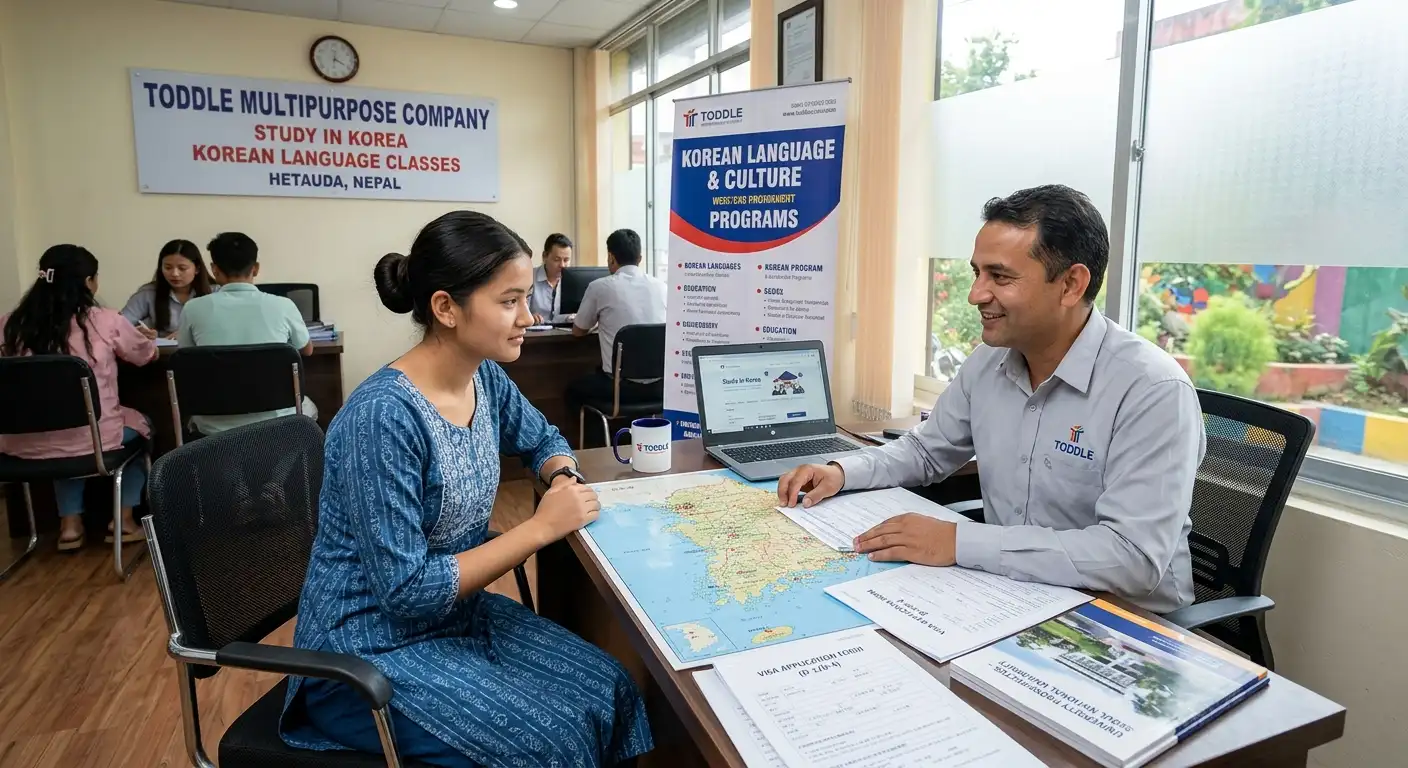
This is where Toddle, based in Hetauda, Makawanpur, fits into the picture for students in Bagmati and beyond who don't want to make repeated trips to Kathmandu for every step. Toddle's counseling covers the actual visa categories discussed in this guide — D-2, D-2 code, and D-4-1 code student visa counseling — alongside dedicated Korean language classes and TOPIK preparation taught in-house, rather than outsourced. The team is led by founder Madhab Sapkota, a TOPIK Level 6 holder and certified Korean language instructor, which matters in a market where a lot of "counselors" have never actually sat the exam themselves. Toddle also works directly with partner institutions such as Gwangju University for undergraduate placement, and runs EPS-TOPIK preparation for students weighing the work-visa route alongside the study route.
If you're weighing your options and want a conversation grounded in your actual GPA, budget, and target program rather than a generic sales pitch, Toddle's Hetauda office (School Road, Hetauda-4, Makawanpur) is a reasonable place to start that conversation locally.
Frequently Asked Questions about Study in Korea from Nepal
1. Can I go to Korea from Nepal without knowing any Korean?
Yes, through the D-4 language track — no prior Korean knowledge is required to enroll in a Korean language program — but you'll need to build proficiency during that year before moving into a degree program.
2. What's the real difference between D-4 and D-2?
D-4 is a language-training visa only and does not permit you to study your major degree program; D-2 is the actual degree visa for bachelor's, master's, or PhD study.
3. How much bank balance do I need to show?
Roughly NPR 8–15 lakh for D-4 and NPR 12–20 lakh for D-2 is the general benchmark, though the exact figure depends on your specific program's cost and duration — always confirm the current figure before applying.
4. Is GKS really fully funded?
Yes — it covers full tuition, a monthly stipend, round-trip airfare, a year of language training, a settlement allowance, and medical insurance for successful applicants.
5. How many GKS seats does Nepal actually get?
Around 2 for the undergraduate Embassy Track and around 4 for the graduate Embassy Track in recent cycles — highly competitive, so apply with a backup plan.
6. Do I need TOPIK to get a D-2 visa?
Not always mandatory for every program, but TOPIK Level 3 is generally the practical minimum, with Level 4+ preferred by most universities, and English test scores (IELTS/TOEFL) are also accepted depending on the institution.
7. Can I work part-time as a student in Korea?
Yes, but only with a proper part-time work permit obtained before you start working — working without one risks your visa status.
8. Does my TOPIK level affect how many hours I can work?
Yes, weekly work-hour limits are generally tied to your TOPIK level, with higher proficiency unlocking more allowed hours.
9. Why do Nepali applicants need a TB test when applicants from some other countries don't?
Nepal is one of several countries, alongside India, China, Vietnam, and the Philippines, for which Korean authorities specifically require a tuberculosis test as part of standard D-2 documentation.
10. How long does visa processing actually take once documents are submitted?
Typically around 2–4 weeks from complete submission at the Embassy in Kathmandu.
11. Can I switch from D-4 to D-2 after my language year?
Yes — this is the standard route for most Nepali students: complete language study, reach the required proficiency, then apply for admission and convert to D-2 for your degree program.
12. What happens after I graduate — can I stay and work in Korea?
Graduates typically move into a D-10 job-seeking visa to search for employment, with longer-term work and residency visas available afterward depending on job offers and language ability.
13. Are Nepali students eligible for scholarships besides GKS?
Yes — including KOICA and university-specific scholarships at institutions such as Seoul National University, KAIST, POSTECH, Yonsei, and UST.
14. How much does it cost to live in Korea per month, excluding tuition?
Roughly ₩1.2–1.5 million per month (about USD 900–1,150) in Seoul, generally somewhat lower in cities outside the capital.
15. Is it worth going through a consultancy instead of applying myself?
It depends on your comfort with document attestation, embassy procedures, and Korean-language prep — a consultancy with genuine local teaching and visa-counseling experience, like Toddle in Hetauda, can meaningfully reduce delays and rejection risk, especially for first-generation applicants navigating MoFA attestation and financial documentation for the first time.
Conclusion: The Honest Path from Nepal to Korea
There's no single "trick" that gets a Nepali student into a Korean university — what actually works is sequencing the boring parts correctly: getting your +2 and SEE transcripts translated and MoFA-attested early, building your bank balance over months instead of days, deciding honestly whether you need the D-4 language year or can go straight to D-2, and treating TOPIK as a four-year investment rather than a box to tick before departure.
Korea rewards students who prepare like this. The tuition and living costs stay manageable compared to Western destinations, GKS and university scholarships are genuinely reachable if you apply with realistic expectations and a backup plan, and a degree from a Korean university opens a real post-graduation pathway through D-10 and eventually longer-term work visas — provided your language skills and documentation are solid from the start.
If you're at the point of turning this guide into an actual application — matching your GPA and budget to the right university, getting your documents in order, or starting TOPIK prep with someone who has actually passed the exam themselves — that's exactly the conversation to have locally before you spend money on translations and attestations for the wrong plan. Toddle's Hetauda office is set up for precisely that first conversation, grounded in your specific profile rather than a generic checklist.
Get the sequencing right, and Korea stops being a maze of visa codes and starts being a plan with a start date.