Most people who plan to go to Korea start with the language. They memorise Hangeul, practise greetings and aim for a TOPIK level. That is the right place to start. But the day you land, you notice that grammar was only half the preparation. The other half is knowing how to greet an older neighbour, what to do before a meal, why people take their shoes off at a dormitory door, and what Koreans mean when they talk about a “seonbae.”
Nobody fails a visa because they used the wrong spoon. But culture shock is one of the most common reasons newcomers feel lonely, embarrassed or overwhelmed in their first months. A good way to reduce it is to meet Korean culture before you leave, through songs, food, film, dress, dance and history, in a classroom where you can ask questions.
That is the idea behind the Korean Culture Class at Toddle in Hetauda. This guide explains what the class covers according to Toddle’s website, how each topic connects to real life in Korea, how it fits with language classes and visa preparation, and how to join. Anything the website does not state, such as fees or entry rules, is marked so you can ask Toddle directly rather than guess.
The Korean Culture Class at a Glance
| Item | Detail (as listed on Toddle’s website) |
|---|---|
| Class | Korean Culture Class |
| Day and time | Every Friday, 8:00 to 10:00 AM |
| Where | Toddle, School Road, Hetauda, Makwanpur, Bagmati Province |
| What it covers | Korean songs, Hanbok (Korean dress), kimchi festival, K-drama, Korean movie show, dance and Korean history |
| Approach | Learn and experience Korean culture before you go, taught hands-on |
| Related weekly class | Abroad Study Preparation Class (ASPC), every Wednesday, 3:00 to 4:30 PM |
| After your visa | 18-hour Pre-Departure Orientation Training (PDOT) |
| Contact | +977 57-525392 and WhatsApp +977 976-9741767 |
Schedules can change. The details above come from Toddle’s website as checked on 30 October 2026, so confirm the current timing by phone or WhatsApp before you visit. The website does not list a separate fee or eligibility rule for the culture class, so ask about both when you contact Toddle.
What the Class Is, and What It Is Not
The Korean Culture Class is a weekly session designed to let learners experience Korean culture before they travel. Toddle’s website describes it as teaching music, food, film, dance and history in a hands-on way, and lists specific themes: Korean songs, Hanbok, a kimchi festival, K-drama, a Korean movie show, dance and Korean history.
It is not a language level, an exam course or a visa service. Those are separate parts of Toddle’s work. The culture class complements them. Think of it as the part of preparation that makes everything else easier to understand.
It also is not a performance. The point is not to become an expert on Korean tradition. It is to arrive in Korea curious, polite and a little less surprised.
Why Culture Belongs Next to Language
Language and culture are tangled together in Korean more than in many languages. Three examples show why.
Honorifics are grammar and etiquette at once. Korean has polite and casual speech levels, often called jondaetmal (존댓말) and banmal (반말). Choosing the wrong level is not only a grammar slip. It can sound rude or oddly familiar. You cannot choose well unless you understand age, seniority and relationship, which are cultural ideas.
Words carry social roles. Words like seonbae (선배, a senior at school or work) and hubae (후배, a junior) describe relationships that shape how students and colleagues talk to each other.
Meals and greetings have set phrases. Before eating, people often say 잘 먹겠습니다 (jal meokgetseumnida), roughly “I will eat well,” and after eating 잘 먹었습니다 (jal meogeotseumnida). Learning the phrase and the moment to use it is language and culture in one step.
If you are starting from zero, a structured basic Korean language class gives you the letters, sounds and sentence patterns. The culture class gives those words a setting. Together they make your first weeks in Korea far less confusing.
Inside the Topics: What Each Theme Teaches
The website lists the themes but not a lesson plan, so what follows is background on why each theme matters, not a description of what happens minute by minute in class. Ask Toddle which themes are scheduled for upcoming Fridays.
Korean Songs
Music is one of the easiest ways into a language. Songs repeat vocabulary, show natural rhythm and make pronunciation stick. Singing along helps you hear how Korean sounds link together, which is one of the things beginners find hardest.
A few cultural points are worth knowing:
- Arirang is a lyrical folk song that UNESCO inscribed on its Representative List of the Intangible Cultural Heritage of Humanity in 2012.
- Noraebang (노래방), literally a “singing room,” is a private karaoke room where friends and colleagues sing together. Many Koreans treat it as a normal social outing, not a performance, so it is useful to know before an invitation arrives.
- K-pop is a global industry, but it is only one slice of Korean music. Traditional music, ballads, trot and indie each have their own audiences.
A practical tip: use songs for listening practice, not as a substitute for study. Lyrics often use casual speech or slang that is not suitable in a formal setting. Treat them as a way to enjoy the language and train your ear.
Hanbok: Korean Dress
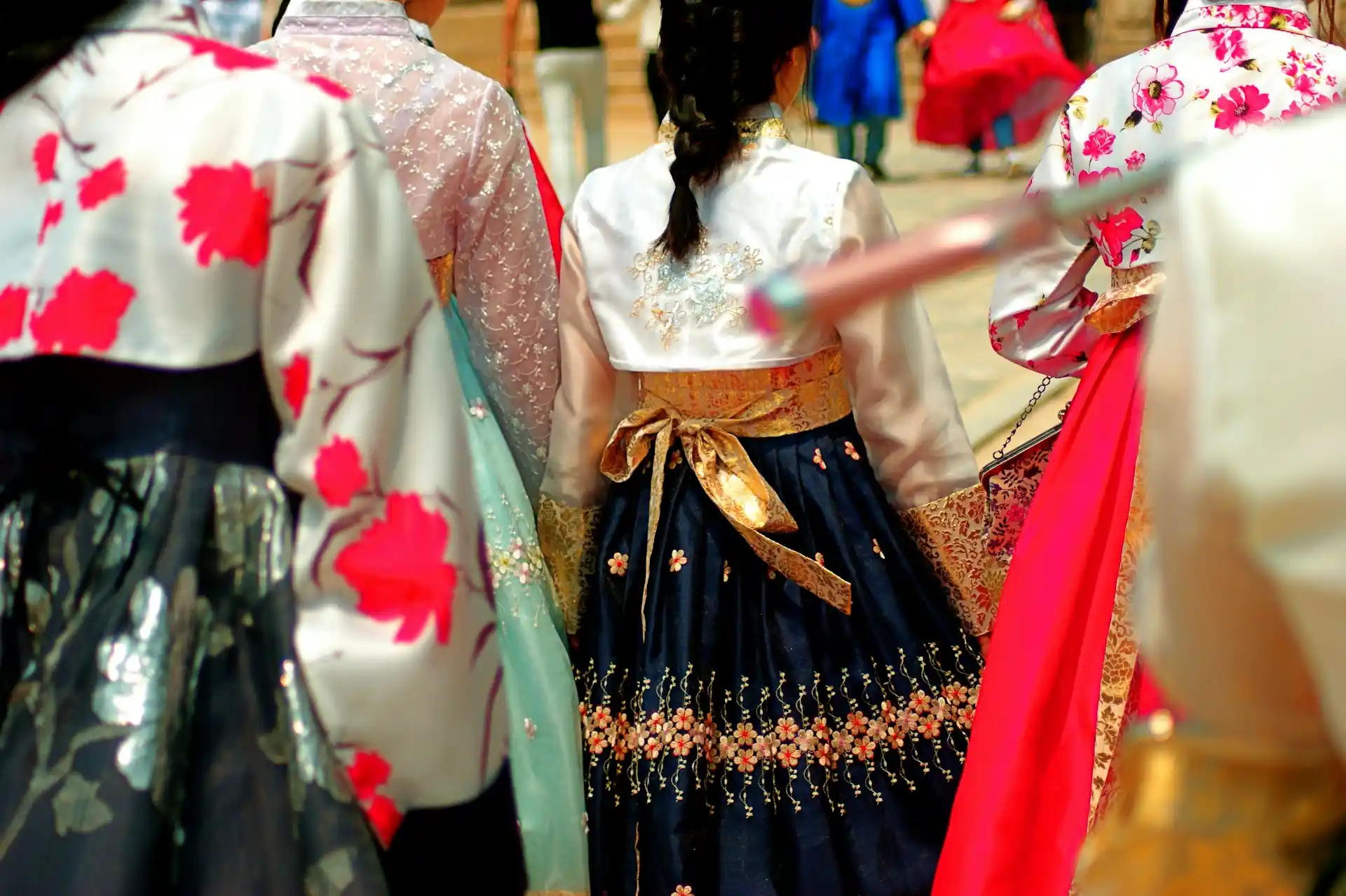
Hanbok (한복) is the traditional Korean dress. A woman’s hanbok typically has a short jacket, jeogori (저고리), worn with a full skirt, chima (치마). A man’s usually pairs the jeogori with trousers, baji (바지). The style familiar from period dramas largely reflects the Joseon era, which lasted from 1392 to 1910.
Today most Koreans wear hanbok on special occasions, such as weddings and major holidays like Seollal (Lunar New Year) and Chuseok (the autumn harvest festival). Visitors can also try it on at cultural sites. Learning about hanbok teaches you more than fashion. It shows how Koreans mark family occasions and how they think about respect, ceremony and tradition.
Kimchi and Korean Food
Food is where many newcomers feel the biggest daily difference. Kimchi, preserved vegetables seasoned with spices and fermented seafood, is part of most Korean meals. UNESCO inscribed Kimjang, the tradition of making and sharing kimchi, on its heritage list in 2013. UNESCO describes it as a late-autumn community practice in which households and neighbours prepare large quantities together so that every family has enough through the winter. You can read the official description on UNESCO’s Kimjang page.
Toddle lists a kimchi festival among the culture class themes. Whatever shape it takes, learning how kimchi is made and shared helps you understand why it matters beyond taste. Toddle’s article on kimchi, the taste of Korea for EPS-TOPIK and study-in-Korea aspirants adds more background.
There are practical points for Nepali learners too:
- Dietary needs. Traditional kimchi is seasoned with fermented seafood, and many Korean dishes include meat or fish-based stock. If you are vegetarian or avoid certain foods, learn the phrases for explaining that and ask about ingredients. Do not assume a dish is meat-free because it looks like vegetables.
- Spice. Many dishes are spicy. Start gently and ask for milder options.
- Table setting. Korean meals often come with many shared side dishes (banchan). Rice and soup are eaten with a spoon, and chopsticks are for side dishes.
K-Drama and Korean Movies
Dramas and films are popular reasons to study Korean, and they are useful. They show everyday speech, workplaces, schools, family dinners and city life, and they train your ear to hear natural conversation.
Treat them as a window, not a map. Dramas exaggerate for entertainment, so real student life is much less glamorous than a series suggests. A film show in class can still be valuable if it comes with discussion: what did the characters do, why did they bow, why did the younger person use that speech level, what would you do in that situation? Those questions turn watching into learning.
Dance
Dance in the culture class is likely to be popular because Korean pop choreography is widely recognised. Beyond pop, Korea has traditional dance with deep roots. UNESCO has inscribed Ganggangsullae, a seasonal harvest and fertility ritual involving a circle dance, on its heritage list as well.
Dance also teaches something practical: group culture. Learning a routine together means watching, following, adjusting and helping each other, which is not far from how many Korean classrooms, clubs and workplaces operate.
Korean History
History explains many things that otherwise seem odd. Here are a few anchor points, kept deliberately short:
- 1443 and 1446. The Korean alphabet, Hangeul, was created under King Sejong the Great and promulgated in 1446 in a document called Hunminjeongeum.
- Joseon (1392 to 1910). A long-lived dynasty whose Confucian values still shape ideas of respect, family and education.
- 1910 to 1945. Korea was under Japanese colonial rule.
- 1950 to 1953. The Korean War ended with an armistice in July 1953, and the peninsula remains divided.
- Later decades. South Korea industrialised rapidly and became a major economy and an influential cultural exporter, a phenomenon often called Hallyu, the “Korean wave.”
You do not need to memorise dates to benefit. What matters is learning why education, effort and family obligations carry such weight, and why some topics need care in conversation. A thoughtful question in class is better than a careless remark in Seoul.
Hangeul and the Day Korea Celebrates It
One of the most charming cultural facts for language learners is that South Korea has a national holiday for its alphabet. Hangeul Day falls on 9 October and commemorates the promulgation of Hunminjeongeum in 1446. Korea’s official portal explains that the script was introduced by King Sejong the Great, who reigned from 1418 to 1450, and you can read more in this Korea.net article on Hangeul Day.
A few details that learners often enjoy:
- The alphabet was originally 28 letters, and modern Hangeul uses 24 basic letters.
- Hangeul was designed to be learned quickly, which is why many beginners can read it within days.
- In 2026, 9 October marked 580 years since the 1446 promulgation, and it fell on a Friday, the same day of the week as Toddle’s culture class.
If you can read Hangeul, you can sound out signs, menus and station names from the first day. That small skill makes a new country feel less foreign.
Etiquette: Small Habits That Make a Big Difference
Etiquette is where a culture class repays itself fastest. The following habits are widely described in Korean etiquette guides, including advice published by Korean government sites for foreign residents. Practices vary by person and setting, so treat these as helpful defaults, not rigid laws.
| Situation | A good default |
|---|---|
| Greeting | A slight bow, deeper for elders or formal situations. A handshake may accompany it |
| Giving and receiving | Use both hands, or your right hand supported by the left at the wrist, especially with elders, documents and gifts |
| Shoes | Take them off when entering a home and in many dormitories, and look for the shoe area at the entrance |
| Meals | Wait for the eldest person to begin. Spoon for rice and soup, chopsticks for side dishes |
| Chopsticks | Do not stand them upright in a bowl of rice, because it resembles a memorial ritual |
| Drinks | Pour for others before yourself and receive with two hands. Do not pour your own drink at a group table |
| Leaving the table | When dining with elders, it is polite to wait until they are ready |
| Public transport | Keep voices low, give seats to older people and avoid loud phone calls |
Age, hierarchy and the question “How old are you?”
Age and seniority shape speech and behaviour. You may be asked your age or birth year early in a friendship, because it helps people decide which speech level to use. Since June 2023, Korea has used international age for most legal and administrative purposes, but social conversations still often turn to birth year and school year.
Seniority also shows up in schools and workplaces. A seonbae is a senior and a hubae a junior, and these roles carry expectations: seniors are often expected to guide, juniors to show respect. Understanding this saves you from misreading friendly behaviour as pressure, or polite behaviour as coldness.
Things that may feel familiar
Nepali learners often notice that some Korean habits are not entirely new: removing shoes at home, respecting elders, using the right hand or both hands to give and receive, and family-centred festivals. Chuseok and Seollal, like Dashain and Tihar, are times when families travel to be together. Spotting those similarities is a comfortable way into the unfamiliar parts.
Things that may feel different
Directness in some settings, strict punctuality, quiet public spaces, formal workplace hierarchy and the pace of life may take adjustment. Toddle’s article on what not to do in Korea covers boundaries worth knowing before you land.
Phrases worth practising
| English | Korean | Say it like |
|---|---|---|
| Hello | 안녕하세요 | annyeonghaseyo |
| Nice to meet you (first time) | 처음 뵙겠습니다 | cheoeum boepgetseumnida |
| Pleased to meet you | 만나서 반갑습니다 | mannaseo bangapseumnida |
| Excuse me | 실례합니다 | sillyehamnida |
| I am sorry | 죄송합니다 | joesonghamnida |
| Thank you | 감사합니다 | gamsahamnida |
| I will eat well (before a meal) | 잘 먹겠습니다 | jal meokgetseumnida |
| That was delicious / thank you for the meal | 잘 먹었습니다 | jal meogeotseumnida |
| Cheers | 건배 | geonbae |
Living Culture: Campus, Dormitory and City
Culture comes alive in ordinary places. A few areas where preparation helps students most:
The dormitory and housing. Korean homes and dormitories often use underfloor heating called ondol, and shoes usually come off at the entrance. Rules about shared spaces, quiet hours and cleanliness can be strict. Toddle’s article on dormitory versus off-campus housing in Korea compares the options and what to expect.
The classroom. Students are often expected to prepare, participate in group projects and respect professors. Group work depends on cooperation and communication, so shyness about speaking Korean can affect teamwork more than grades.
Clubs and social events. Many campuses have student clubs and social gatherings. Group dinners and trips are common ways to build friendships, and customs about drinking, pouring and leaving early are good to know in advance. Nobody should feel pressured to drink, and it is acceptable to decline politely.
City life. Public transport is extensive, cafes double as study spaces, and delivery and mobile payment are part of everyday life. The wider picture of daily life is covered in Toddle’s guide to student life in Korea.
Culture, Your Visa and Your Application
Cultural preparation is not a substitute for documents or finances, but it helps in three places.
Interviews and screening. Questions such as “What do you know about Korea?” and “Why Korea?” are common in university screening, and a thoughtful, accurate answer reads better than a generic one. The culture class gives you real material to draw on, such as what you learned about food, language or history. Toddle’s guide to Korea student visa interview questions shows how these questions are usually asked. Remember that no consultancy or class can guarantee an interview or visa result.
Your statement of purpose. Universities like to see evidence that you understand Korea and have prepared for it. Mentioning that you have attended a weekly culture class and studied Korean is more convincing than saying you love Korean dramas. Toddle’s guide to writing an SOP for a Korean university explains how to describe your preparation honestly.
Settling in. The more you know about daily norms, the faster you adapt. That matters for your studies, your part-time work (where permitted), your relationships and your wellbeing.
For Workers: Cultural Skills on the Job
Culture is just as important for EPS workers. A Korean workplace often runs on clear hierarchy, punctuality, safety instructions and teamwork. Knowing how to greet colleagues, ask for clarification politely, follow safety messages and respond to feedback helps you integrate and stay safe. Nepal and Korea signed their EPS agreement in 2007, and since recruitment began in 2008, many Nepalis have worked in Korean factories and farms. A little cultural preparation goes a long way when you are working far from home.
Who Should Join
| If you are... | How the class can help |
|---|---|
| Planning to study in Korea (D-2 or D-4) | Builds cultural awareness for interviews, SOPs and campus life |
| Preparing for EPS-TOPIK or an E-9 job | Introduces workplace and daily-life norms |
| Learning Korean for TOPIK | Gives language a real-world setting |
| A K-pop, K-drama or K-food fan | Turns interest into informed understanding |
| A parent supporting a child who is going to Korea | Helps you understand what daily life will be like |
| Simply curious | A relaxed way to explore a culture |
Whether younger learners, parents or visitors can join, and whether there is a fee, is not stated on the website. Ask Toddle directly.
How to Get the Most From Each Session
Before class. Know the day’s theme if Toddle shares it, and think of one question you want answered.
During class. Take notes, especially on phrases and etiquette. Try the phrases aloud, even if you feel shy. Ask why customs exist, not only what they are.
After class. Practise one new phrase or habit during the week. Review your notes. Connect what you learned to your language class vocabulary.
Over time. Keep a small notebook of “culture notes”: things that surprised you, questions you still have and phrases you want to use. Bring it to your pre-departure orientation.
Keep a balanced view. Korean culture is diverse and changing. Avoid treating any one custom as universal for every person.
How the Culture Class Fits Toddle’s Pathway
Toddle presents its work as a connected path. Based on its website, the main parts are:
| Stage | What Toddle lists |
|---|---|
| Counselling | Free counselling to match your academics, budget and goals to a visa type and university |
| Korean classes | Seven levels, from Basic I to Post Master, with books included in the fee |
| Weekly classes | Korean Culture Class on Fridays, 8:00 to 10:00 AM, and ASPC on Wednesdays, 3:00 to 4:30 PM |
| Applications | ASPC covers document preparation, SOP writing, interview preparation and application form filling |
| Visa and departure | Visa filing, then the 18-hour Pre-Departure Orientation Training (PDOT) |
The website describes PDOT as covering course registration, daily life in Korea and scam protection, and says it also deals with banking, part-time work rules, housing and arrival. Toddle’s article on pre-departure orientation for Korea explains what to expect from that stage. The culture class comes earlier and is more relaxed: it builds the cultural background that makes orientation easier to absorb.
The Korean language course in brief
The website lists the following Korean levels, with fees in NPR excluding VAT and books included. These figures were on the website on 30 October 2026, so confirm them before you plan.
| Level | Duration | Fee (NPR) |
|---|---|---|
| Basic I | 2 months | 10,000 |
| Basic II | 3 months | 10,000 |
| Advanced | 4 months | 10,000 |
| Upper Advance | 3 months | 15,000 |
| Master Class | 3 months | 18,000 |
| Upper Master | 3 months | 20,000 |
| Post Master | 3 months | 22,000 |
Toddle also lists package discounts and says new students can join a running class at any time. The website states that it has been teaching in Hetauda since 2018, reports more than 1,000 students taught and says its students attend more than 30 Korean universities. Those are Toddle’s own statements.
Why a Local Class Matters
Hetauda is the capital of Bagmati Province, and many learners from Hetauda and nearby parts of Makwanpur otherwise travel to Kathmandu for Korea-related preparation. A weekly class close to home saves travel time and rent, and it lets you build a routine. It also lets families see what their child is preparing for, which can ease worries.
Learning in a group has its own benefits. You hear other people’s questions, practise phrases with classmates and make friends who are on the same journey. Some of those friendships continue in Korea.
Visiting Toddle
| Item | Detail |
|---|---|
| Address | School Road, Hetauda-4, Makwanpur, Bagmati Province |
| Phone | +977 57-525392 |
| +977 976-9741767 | |
| info@toddle.com.np | |
| Hours listed on the website | Sunday to Friday, 6:30 to 7:30, closed on Saturday |
Because the website lists the hours without stating morning or evening, call or message before you visit to confirm timing, especially for the Friday class.
Join the Korean Culture Class: Talk to Toddle
If you are planning to study or work in Korea, or you simply want to understand Korean culture before you go, the weekly Korean Culture Class is a practical, friendly place to start. Ask about the upcoming themes, whether there is a fee and who can attend, and pair it with the Korean language level that suits you.
- Book a free counselling session to plan your route, language level and timeline.
- Visit the contact page for directions and ways to reach the team.
Message Toddle on WhatsApp: +977 976-9741767
You can also call +977 57-525392 or visit Toddle at School Road, Hetauda-4, Makwanpur.
For official information on studying in Korea, the government’s Study in Korea portal is a reliable place to read about universities, scholarships and student life.
Frequently Asked Questions
1. What is the Korean Culture Class at Toddle?
It is a weekly class in Hetauda where learners explore Korean culture before travelling to Korea. According to Toddle’s website, themes include Korean songs, Hanbok, a kimchi festival, K-drama, a Korean movie show, dance and Korean history.
2. When is the Korean Culture Class held?
Toddle’s website lists it every Friday from 8:00 to 10:00 AM. Schedules can change, so confirm the current timing by phone or WhatsApp before you attend.
3. Where is the class held?
At Toddle, School Road, Hetauda-4, Makwanpur, Bagmati Province.
4. Is the culture class free?
The website does not list a separate fee for the culture class. Contact Toddle to ask about fees and whether it is included with a Korean language course.
5. Who can join the class?
The website does not state eligibility rules. It is designed for people preparing for Korea, but ask Toddle whether other learners, younger students or parents can attend.
6. Do I need to know Korean to join?
The website does not list a language requirement. A beginner can benefit from cultural learning, and a basic language class helps you get more out of it.
7. Is the culture class a replacement for a Korean language class?
No. It complements language study. Language classes teach grammar, vocabulary and test skills, while the culture class gives context.
8. Will the class help with my visa?
It can help you prepare for interviews and statements by giving you real knowledge about Korea. It does not replace documents, finances or visa counselling, and no class can guarantee a visa result.
9. What is Hanbok?
Hanbok is traditional Korean dress. It typically includes a jacket called jeogori, worn with a skirt (chima) or trousers (baji), and is commonly worn on special occasions and holidays.
10. Why is kimchi culturally important?
Kimchi is part of most Korean meals, and the tradition of making and sharing it, called Kimjang, was inscribed on UNESCO’s heritage list in 2013. It reflects sharing and community, as well as food.
11. Is kimchi vegetarian?
Not necessarily. Traditional kimchi is seasoned with fermented seafood, and some versions use other animal-based ingredients. If you avoid certain foods, learn the phrases to ask about ingredients.
12. What is Hangeul Day?
It is a South Korean holiday on 9 October commemorating the 1446 promulgation of the Korean alphabet under King Sejong the Great. In 2026 it marked 580 years since that promulgation.
13. What is a seonbae?
A seonbae (선배) is a senior in school, a club or a workplace, while a junior is a hubae (후배). The terms describe relationships that shape how people speak and behave.
14. What is the difference between polite and casual Korean?
Korean has speech levels. Polite speech (jondaetmal) is used with elders, strangers and in formal settings, while casual speech (banmal) is used with close friends or younger people. Choosing the right level is both language and etiquette.
15. Why do people take off their shoes indoors in Korea?
It is a common habit in homes, and many dormitories and some restaurants follow it. Korean homes often use underfloor heating called ondol, and keeping the floor clean matters.
16. What are the basic table manners in Korea?
Wait for the eldest person to begin, use the spoon for rice and soup and chopsticks for side dishes, and do not stand chopsticks upright in rice. Pour drinks for others, and receive with two hands.
17. Why do Koreans use both hands?
Giving and receiving with both hands, or with the right hand supported by the left, shows respect, especially with elders, documents and gifts.
18. Do Nepali and Korean customs have anything in common?
Some habits may feel familiar, such as removing shoes at home, respecting elders and celebrating family-centred festivals. Customs vary by family, so treat these as general similarities.
19. Will learning culture help EPS workers?
Yes. Workplace culture in Korea often emphasises hierarchy, punctuality, safety instructions and teamwork. Knowing basic greetings and etiquette helps you integrate and communicate.
20. What is the Pre-Departure Orientation Training?
PDOT is an 18-hour orientation Toddle lists for students after the visa stage. The website says it covers course registration, daily life in Korea and scam protection, and also deals with banking, part-time work rules, housing and arrival.
21. What is ASPC?
The Abroad Study Preparation Class is a weekly Wednesday class from 3:00 to 4:30 PM that Toddle lists as helping with document preparation, SOP writing, interview preparation and application form filling.
22. Can I attend the culture class and a Korean language class at the same time?
Toddle describes its classes as complementary, and new students can join a running class at any time. Ask the team how to schedule both.
23. How do I register?
Contact Toddle by phone on +977 57-525392, message on WhatsApp at +977 976-9741767 or book a free counselling session through the website.
24. Will watching K-dramas prepare me for life in Korea?
They help your listening and give a sense of daily life, but they exaggerate for entertainment. Combine them with structured study, discussion and real preparation such as a culture class and orientation.