Abroad Study in Japan
Abroad Study Counseling Services
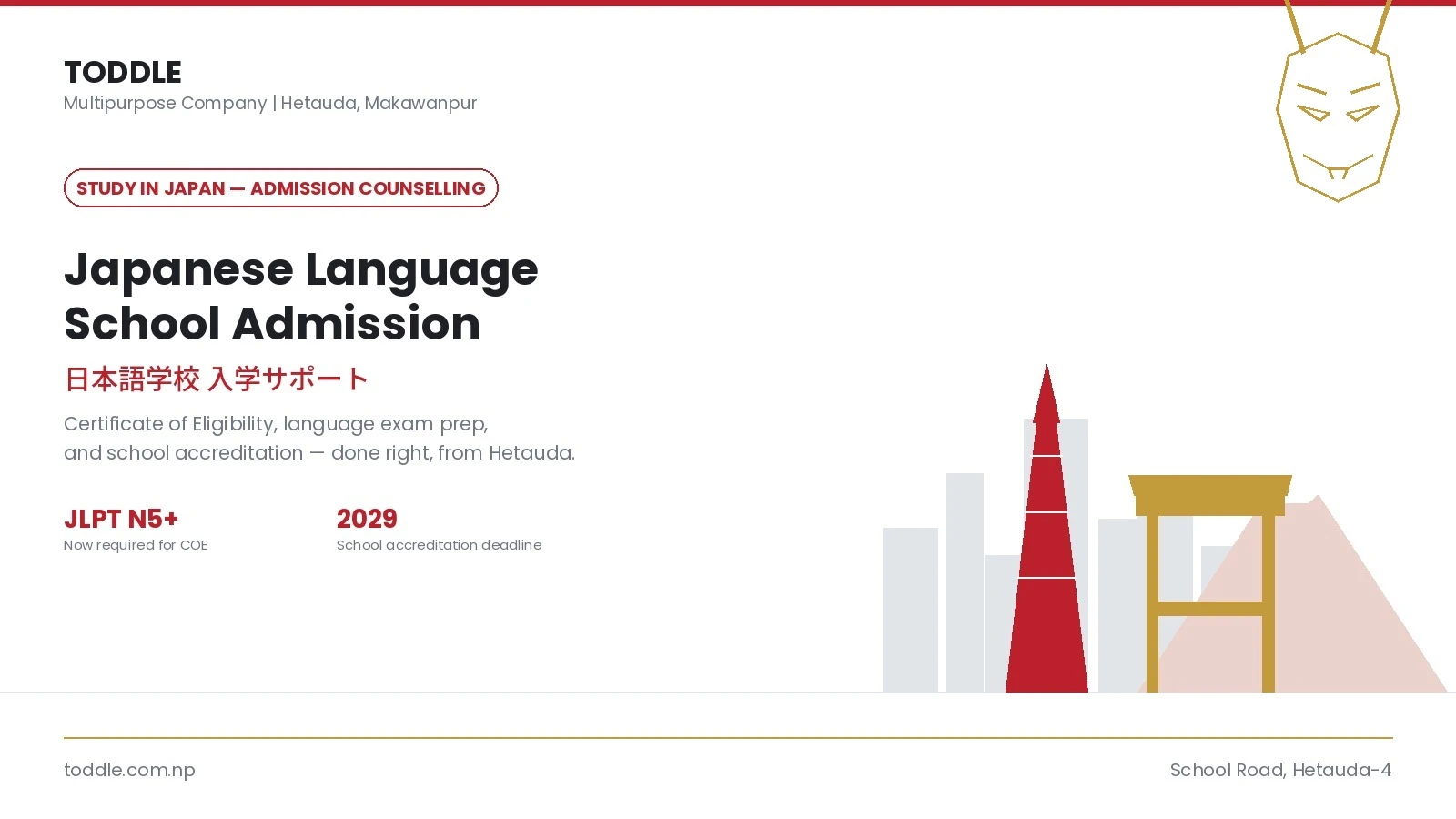
Getting into a Japanese language school isn't just about picking a good program — Japan's immigration system has real, specific requirements around your language ability, your chosen school's official standing, and a visa process that runs through two separate government stages. Rules have also changed significantly in 2026. This page walks through exactly what Japan's Immigration Services Agency and Ministry of Education require, and how we guide you through each step.
Unlike some countries where you apply for a visa directly, Japan's student visa process works in two distinct stages, governed by the Immigration Control and Refugee Recognition Act:
COE processing itself typically takes one to three months, though this varies by region and gets slower during peak intake seasons (March–April for the April semester, August–September for the October semester). Plan your application timeline around this, not the other way around.
This is the single biggest change affecting new applicants right now, and it's exactly why language preparation isn't optional anymore. On April 10, 2026, Japan's Immigration Services Agency announced that the old standard — simply showing a certificate for 150 hours of Japanese study — is no longer sufficient on its own. Going forward, applicants must demonstrate genuine Japanese ability through one of the following before their COE will be approved:
This is rolling out in two phases: renewals and changes of status from July 1, 2026, and new COE applications from the October 2026 intake onward. Self-study records, app screenshots, or informal certificates are explicitly not accepted — your proficiency needs to be verified through a recognized, structured exam.
This is exactly where our NAT-N5 preparation course fits directly into your visa application, not just your language skills — passing an ISA-recognized exam is now a hard eligibility requirement, not a nice-to-have.
Japan's system for certifying which schools can even accept international students is genuinely more layered than most countries', and it's mid-transition right now — worth understanding clearly before you commit to any school.
Historically, a language school needed to be designated a Notified School (法務省告示校) by the Ministry of Justice to accept "Student" status international applicants at all. Among these, schools demonstrating especially well-managed student oversight — attendance tracking, part-time work compliance, and similar factors — are further designated Appropriate Schools (適正校), split into Class I and Class II. Class I schools, the higher standard, benefit from simplified document submission when their students apply for visas.
Since April 2024, Japan has been rolling out an entirely new certification system, administered directly by the Ministry of Education, Culture, Sports, Science and Technology (MEXT) rather than the immigration authority. Schools that pass this review become a Certified Japanese Language Education Institution (認定日本語教育機関). This is a separate system from Appropriate School status — a school can hold one without the other, and they're evaluated on different criteria entirely (MEXT reviews actual educational quality; the Appropriate School system reviews immigration/enrollment management).
Old-system Notified Schools are only permitted to continue accepting international students during a five-year transition period, ending March 31, 2029. After that date, any school that hasn't secured MEXT certification under the new system will no longer be able to accept "Student" status international applicants at all. As of the most recent published figures, only around 96 institutions nationwide had secured the new certification, against more than 700 schools operating under the old Notified School system — meaning most schools are still mid-transition.
This is precisely why we verify a school's current accreditation status — both its Appropriate School classification and its MEXT certification progress — before recommending it, especially for any program that would extend close to or past the 2029 transition deadline.
You'll need to demonstrate you (or a sponsor) can cover tuition and living expenses for your stay. The exact amount depends on your specific school, program length, and whether you're self-funded or sponsored — we confirm the precise current figure with you directly, since requirements vary school to school rather than following one fixed national number.
Yes, as of the 2026 policy change — a 150-hour study certificate alone is no longer sufficient. You need a JLPT N5 (or higher), NAT-TEST, BJT, J.TEST, or other ISA-approved exam result.
A Notified School is the base immigration designation allowing a school to accept international students. Appropriate School (Class I/II) is a further immigration designation for well-managed schools, offering simplified visa documentation. Certified Japanese Language Education Institution is a separate, newer MEXT-administered system reviewing actual educational quality. A school can hold any combination of these — we check what your specific school actually has.
If your school hasn't secured MEXT certification by March 2029, it may no longer be able to accept international students afterward. For any longer program, this is worth checking before you enroll.
COE issuance typically takes one to three months, plus a few working days for visa stamping once you have your COE. Peak intake seasons can extend this — we help you plan your timeline realistically.
Yes, with separate permission — up to 28 hours per week during term, and up to 40 hours per week during long school vacations, with some restrictions on the type of work.
Bring your academic background and come talk to us at our Hetauda office — we'll check your language exam readiness, help you choose a properly accredited school, and walk you through the full COE and visa timeline honestly. Prefer to start from your phone? WhatsApp us at +977 9769741767 and we'll get you started.
Visa requirements and school accreditation rules are based on official Japanese government guidance and are subject to change, particularly given Japan's ongoing 2024–2029 school certification transition. We confirm current requirements with you directly during your consultation.
