Gwangju Women's University
Study in South Korea: Gwangju Women's University (광주여자대학교)
Gwangju Women's University — known in Korean as 광주여자대학교, and internationally by its initials KWU — holds a distinction no other university in South Korea can claim: it is the only four-year, comprehensive women's university located outside Seoul in the entire country. Every other full university-level women's institution in Korea is in the capital; every other regional women's school is a two- or three-year junior college. For a Nepali student weighing where to study, that single fact says a lot about what kind of institution this is — a genuine, full degree-granting university built specifically around women's education, in one of Korea's most historically and culturally significant cities.
University History
Gwangju Women's University was founded on January 31, 1992, established by Oh Chi-seok under the Songgang Educational Foundation (학교법인 송강학원). It opened its doors on March 25, 1992, as Gwangju Women's Junior College (광주여자전문대학). On December 21, 1996, it was upgraded to full four-year comprehensive university status and took its current name, Gwangju Women's University.
The university is located in Gwangsan-gu, one of Gwangju's districts, at 여대길 201 (Yeodae-gil 201). Its English initials, KWU, happen to be shared with Kwangwoon University in Seoul — worth knowing so you don't mix up the two while researching online, since Kwangwoon uses the domain kw.ac.kr while Gwangju Women's University uses kwu.ac.kr.
Important: How International Admission Actually Works Here
Gwangju Women's University is a women's university for its regular, domestic undergraduate departments — but it has specifically opened international admission to both men and women through a dedicated track. Following a recent revision to its academic regulations, the university established the Global Convergence School (글로벌융합학부), with a capacity of 100 students, as a program specifically for international students — and this track admits both male and female foreign applicants. A parallel track, the Future Convergence School (미래융합학부), serves adult learners on the same basis.
These two tracks are structured as entirely separate programs from the university's regular departments (like Nursing, Early Childhood Education, or Beauty Science, discussed below) — domestic female students cannot enroll in these two tracks, and they exist specifically to bring international and non-traditional students into the university through their own dedicated curriculum.
What this means practically: if you're a male student interested in studying here, your pathway is the Global Convergence School specifically, not a direct application into one of the traditional women-only departments. If you're a female student, you can apply through either the Global Convergence School or, depending on the department and its specific international admission policy, potentially through a regular department's international quota — we confirm the exact current pathway for your situation and intended field of study directly with the university.
Academic Structure and Departments
Rather than being divided into traditional colleges, Gwangju Women's University organizes its undergraduate programs into five academic tracks: Humanities and Social Sciences, Education, Health Sciences, Natural Sciences, and Arts and Physical Education. Across these tracks, the university offers 2 schools, 18 departments, and 5 majors at the undergraduate level, along with graduate programs (7 master's departments and 2 doctoral departments in its general graduate school, plus a separate graduate school of education and graduate school of social development).
Some departments are particularly well-regarded and worth knowing about specifically:
- Nursing (간호학과) — widely considered the university's strongest program, with solid graduate employment outcomes, and one of only three departments offering a doctoral track
- Early Childhood Education (유아교육과) and Special Education (특수교육과, covering both elementary and secondary tracks) — popular, respected teacher-licensure programs; the university has become known as an emerging strong choice for special education teacher licensure exam success
- Social Welfare — a consistently strong department, in line with the university's broader strength in health and human-services fields
- Beauty Science (미용과학과) — genuinely notable: this was the first four-year beauty science department established in Korea, it's the top producer of certified vocational beauty educators nationally, and it's one of only three departments offering a doctoral track
- Sports Studies (스포츠학과) — a newer department, admitting its first cohort in 2023, including dedicated volleyball and basketball athlete recruitment
- Police Administration and Law, Physical Therapy, and Hotel & Tourism Management — additional established programs with dedicated admission tracks
A Notable Strength: Archery
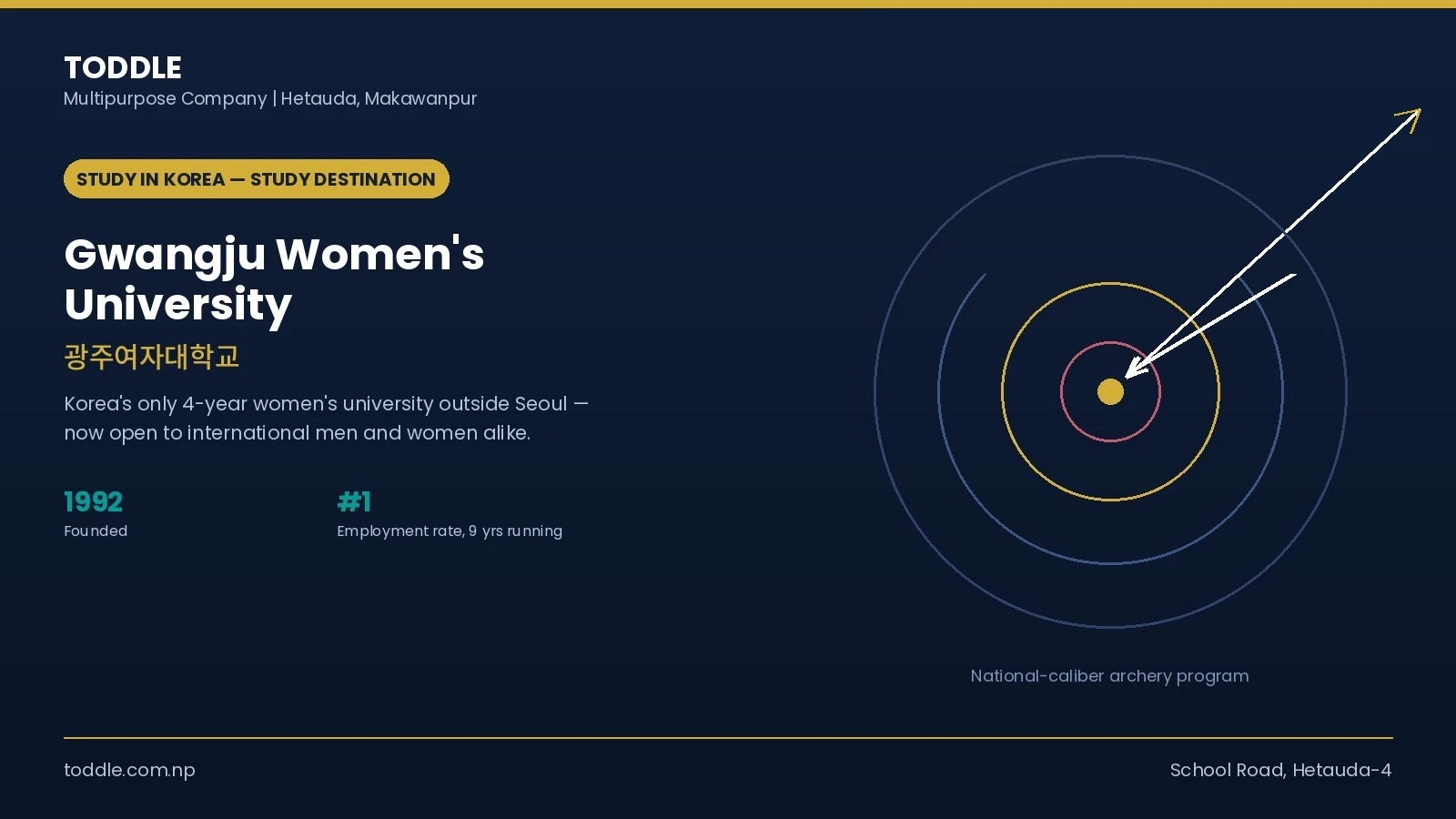
Gwangju Women's University has built a genuinely national-caliber archery program, training students to competitive standard at its own dedicated facility (the Gwangju Women's University Universiade Gymnasium). Its most famous alumna is Ki Bo-bae, who won individual and team gold in archery at the 2012 London Olympics and team gold at the 2010 Guangzhou Asian Games — a level of achievement that puts this university's archery program on the map nationally, not just regionally.
Employment Outcomes
The university has ranked #1 in employment rate among all women's universities in Korea for nine consecutive years, and has separately been recognized as an Employment-Linked Priority University for the same period — a genuinely strong, sustained track record worth knowing if graduate employability is part of your decision.
Gwangju: The City Itself
Gwangju is a major metropolitan city in southwestern South Korea, historically the heart of the Jeolla region, and administratively its own metropolitan city since 1986. A few things worth knowing before you commit to studying here:
- Historical significance: Gwangju is where the May 18 Democratic Uprising took place in 1980 — a pivotal, deeply significant moment in Korea's transition to democracy, commemorated citywide and recognized internationally, including in UNESCO's Memory of the World register for related archival records. Studying in Gwangju means studying in a city that played a direct role in modern Korean history.
- A recognized arts and culture city: Gwangju hosts the Gwangju Biennale, one of Asia's most significant contemporary art exhibitions, and carries a strong identity as a center for Korean arts and culture more broadly.
- Known for food culture: Gwangju has a strong reputation within Korea for its food, often cited among the country's best regional cuisines.
- More affordable than Seoul: Cost of living in Gwangju is meaningfully lower than in Seoul or Incheon, which matters directly for a student's day-to-day budget over several years.
Tuition and Fees — What We Can Confirm, and What We Verify Directly
Being transparent here matters more than giving you a number that might be wrong: we were not able to confirm a single official, current tuition figure specific to Gwangju Women's University from public sources at the time of writing. As a general reference point, undergraduate tuition across universities in Gwangju city broadly ranges from approximately 2,160,000 to 21,290,000 KRW per year, depending on the institution and program — private university programs in health and humanities fields (like nursing or early childhood education) typically sit in the middle of this range rather than at either extreme.
Because tuition is set and revised by the university itself each academic year, and can vary meaningfully by department, we confirm the exact current published fee for your specific intended major directly with the university before you apply — not from a general estimate.
Why Consider Gwangju Women's University
- A genuine four-year degree-granting university, not a junior college — with the distinction of being the only one of its kind for women outside Seoul
- Open to both male and female international students through the dedicated Global Convergence School track
- Particularly strong options if you're considering nursing, early childhood or special education, or social welfare — fields with real regional demand
- Ranked #1 in employment rate among Korean women's universities for nine consecutive years
- Lower cost of living than Seoul, without sacrificing access to a real Korean metropolitan city
- A city with genuine historical and cultural depth, not just a place to pass through during your studies
A Note of Honesty
In keeping with how we counsel every student, we won't oversell this university. Regionally, Gwangju Women's University's overall academic reputation is considered modest outside of its stronger programs — nursing, beauty science, and the education-track departments in particular perform noticeably better than the university average, and the new Global Convergence School track is recent enough that its own track record is still developing. If you're considering this university, we'll walk you through exactly which departments and tracks have strong outcomes, so your decision is based on the real picture, not just the campus brochure.
How Toddle Helps With Your Gwangju Women's University Application
- Honest guidance on which departments and tracks genuinely fit your academic goals, career plans, and eligibility as an international applicant
- Full document preparation — academic transcripts, Statement of Purpose, and application forms
- Direct confirmation of current tuition and financial requirements for your specific department before you commit
- Complete visa counselling once you're admitted — see our Study in Korea and D2 Visa pages for the full process
Frequently Asked Questions
Can male students apply to Gwangju Women's University?
Yes — through the dedicated Global Convergence School, a track created specifically for international students that admits both men and women. Regular domestic undergraduate departments remain women-only.
What is Gwangju Women's University best known for academically?
Nursing is generally considered its strongest program, alongside solid teacher-licensure tracks in early childhood and special education, and a genuinely distinctive beauty science department — the first four-year program of its kind in Korea.
Is Gwangju a good city for international students?
It's a major metropolitan city with real historical significance, a strong arts and culture scene (including the Gwangju Biennale), and a noticeably lower cost of living than Seoul — a solid option for students who want a genuine Korean city experience without Seoul's price tag.
How much does tuition cost?
We don't want to quote you an unconfirmed number — tuition varies by department and is set annually by the university. We confirm the exact current figure for your specific intended major directly before you apply.
Interested in Applying to Gwangju Women's University?
Come talk to us at our Hetauda office — we'll walk you through the departments and tracks that genuinely fit your goals, confirm real, current costs, and guide you through the full D2 visa process from application to arrival. Prefer to start from your phone? WhatsApp us at +977 9769741767 and we'll get you started.
University information is drawn from official Korean-language sources and is subject to change; we confirm current department offerings, admission requirements, and tuition directly with the university before you apply.