Sun Moon University
Study in South Korea: Sun Moon University (선문대학교)
Sun Moon University is one of the more internationally diverse universities in South Korea, and it has a genuinely deep, structured infrastructure for foreign students — including its own dedicated language institute campus. It also has a founding history you should know clearly before applying. This page lays out the full picture honestly: the university's real origins, its academic structure, what studying there actually looks like, and what to weigh before deciding.
University History
Sun Moon University (선문대학교, English abbreviation SMU) was formed through the merger of two theological institutions: the Unification Theological Seminary (통일신학교), founded on April 3, 1972 in Guri, Gyeonggi-do by Sun Myung Moon, founder of the Unification Church, and Sung Hwa Theological Seminary (성화신학교), founded in 1985 in Cheonan under the Sung Hwa Educational Foundation.
The founding timeline in full: preparatory work began in 1979, with the Sung Hwa Foundation established in Cheonan in May 1984 and Sung Hwa Theological Seminary receiving formal school status in December 1985, opening its first class of 40 theology students in March 1986. The institution was upgraded to full four-year college status in October 1989 as Sung Hwa College, and to university status in 1991. It was renamed Sun Moon University in the early-to-mid 1990s. The university's founding foundation itself has changed names over time — from Sung Hwa Foundation to Sun Moon Foundation, and again in 2017 to its current name, Seonhak Foundation.
The university's founding philosophy is expressed as three principles: 애천 (Love Heaven), 애인 (Love Humanity), and 애국 (Love Country).
A Note of Honesty: The University's Religious Affiliation
We believe you deserve this information clearly, not glossed over. Sun Moon University's founding and governing foundation is affiliated with the Unification Church (also known internationally as the Family Federation for World Peace and Unification), founded by Sun Myung Moon. The university operates as an accredited, government-recognized academic institution offering standard degree programs — it is not a religious seminary for general students — but its ownership and founding history are directly tied to this religious movement, and several affiliated K–12 schools in Korea (including a well-regarded international school) share the same foundation.
One visible reflection of this on campus: Sun Moon University has a Theology and Chastity College, which includes a Chastity and Family Culture Department — the only department of its kind at any Korean university, reflecting values the Unification Church specifically emphasizes. This department was originally established in 1999 under a more direct name, and was restructured and renamed in 2010 following public criticism.
We're telling you this plainly because it's the kind of thing a student or family should factor into their decision before applying, not discover afterward. It doesn't mean the university isn't a legitimate place to earn a real, internationally recognized degree — it is — but you should choose it with full awareness of what you're choosing.
Campuses: Asan and Cheonan
Sun Moon University operates across two campuses in Chungcheongnam-do (South Chungcheong Province):
- Asan Campus (아산캠퍼스) — the university's main campus, located in Tangjeong-myeon, Asan-si, where the majority of academic departments and facilities are based
- Cheonan Campus (천안캠퍼스) — now used specifically as the home of the Korean Language Institute, where foreign students study Korean before or alongside their degree studies
The Korean Language Institute — Directly Relevant If You're Starting From Zero Korean
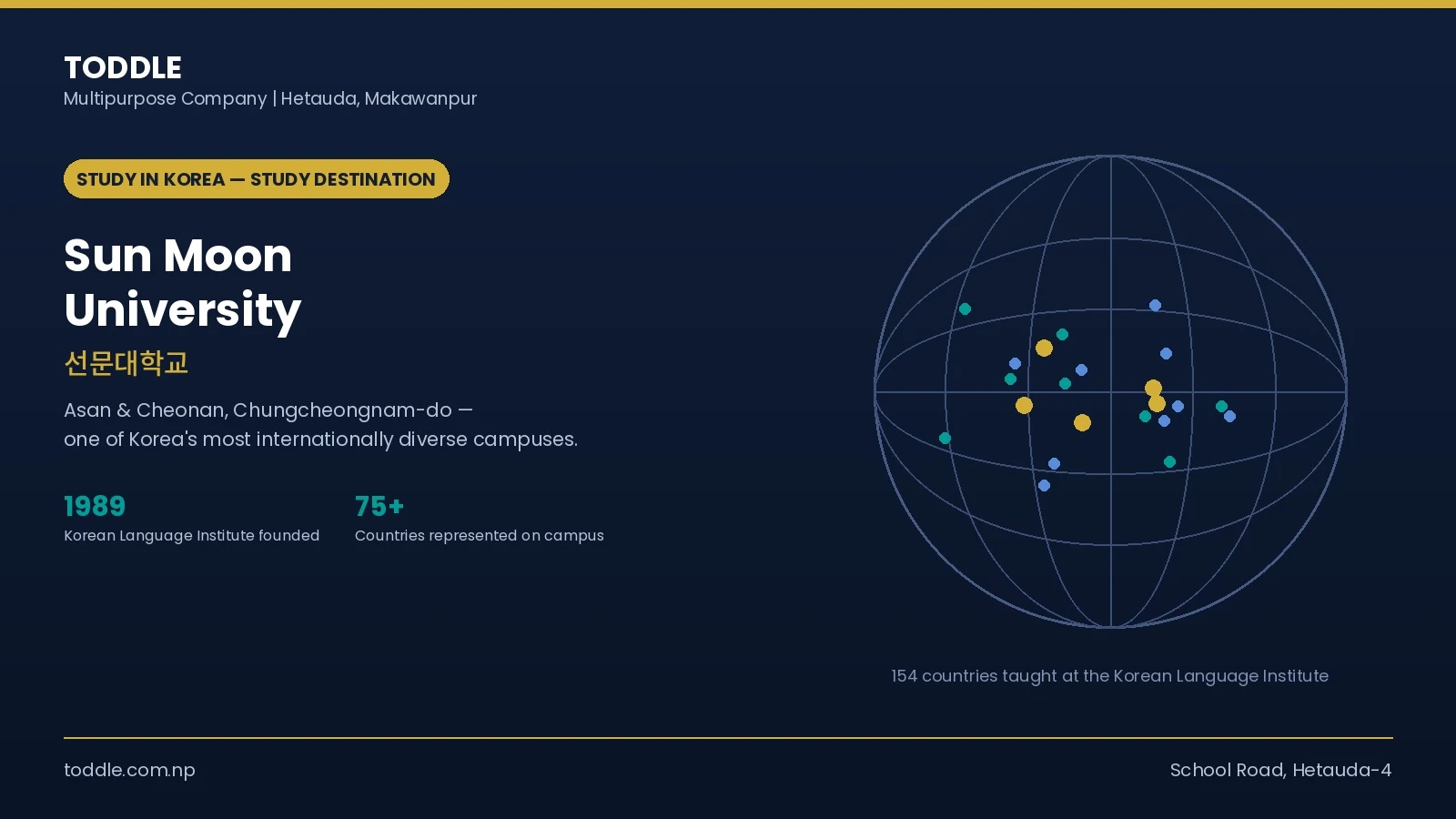
This is one of the most practically useful things about Sun Moon University for a Nepali student: its Korean Language Institute (한국어교육원) was established on March 20, 1989, with the explicit mission of teaching Korean language and culture to an international audience. As of its most recent published figures, it has taught a cumulative total of over 27,000 students from 154 countries, with many going on to enroll in degree programs at Sun Moon University itself or other major Korean universities.
Sun Moon University is an officially designated TOPIK testing site, running the exam six times a year on campus — genuinely convenient if you're studying there and need to sit TOPIK without traveling elsewhere. The university describes itself as one of Korea's most internationalized campuses, citing more than 75 countries represented among its current student body in a typical year.
If you're starting your Korea journey through language study first, this is the same D-4-1 visa pathway covered on our D4-1 Code Student Visa page — worth reading alongside this one, since Sun Moon's language institute is exactly the kind of program that pathway applies to.
Academic Structure and Departments
Sun Moon University is organized into several colleges:
- College of Humanities and Social Sciences (인문사회대학)
- Global Business and Foreign Languages College (글로벌비즈니스외국어대학)
- College of Health Sciences (건강보건대학) — home to the university's most competitive, popular departments: Nursing, Dental Hygiene, Physical Therapy, and Emergency Medical Services
- College of Engineering (공과대학)
- General Education Center (교양교육원)
- Theology and Chastity College (신학순결대학) — covered in the honesty section above
If your priority is employability and program strength specifically, the Health Sciences college is where Sun Moon University is generally considered strongest — Nursing, Dental Hygiene, Physical Therapy, and Emergency Medical Services are consistently described as its most competitive and sought-after departments.
Tuition and Fees — What We Confirm Directly
As with every university we counsel on, we won't quote you a specific tuition figure we haven't verified. Sun Moon University's international admissions office publishes current tuition invoices directly to admitted students each intake cycle, and fees vary by department and program level. We confirm the exact current figure for your specific intended major directly with the university's Global Admission office before you apply — not from a general estimate.
Getting There
The Asan campus is approximately a three-hour journey from Incheon International Airport — worth factoring into your arrival planning, particularly if you're arriving as a new international student and need to coordinate pickup timing with the university.
Why Some Students Choose Sun Moon University
- A genuinely large, well-established international student population and support infrastructure — not a small, ad-hoc program
- A dedicated Korean Language Institute campus with decades of experience teaching foreign students, and on-site TOPIK testing
- Strong, competitive programs specifically in Nursing, Dental Hygiene, Physical Therapy, and Emergency Medical Services
- On-campus dormitory housing available to all international students
How Toddle Helps With Your Sun Moon University Application
- A full, honest briefing on the university's background — including its religious foundation — so you're deciding with complete information
- Guidance on choosing between the Korean Language Institute pathway (D-4-1) or direct degree admission (D-2), based on your current language level
- Full document preparation and direct confirmation of current tuition for your intended department
- Complete visa counselling from application through arrival — see our Study in Korea, D2 Visa, and D4-1 Code pages for the full process
Frequently Asked Questions
Is Sun Moon University a religious school I'd be required to follow?
It's an accredited academic institution offering standard degree programs, not a seminary for general students — but its founding foundation is affiliated with the Unification Church, and this is worth knowing and considering before you apply.
Can I study Korean there before starting a degree?
Yes — the Korean Language Institute on the Cheonan campus is specifically built for this, with decades of experience teaching international students and on-site TOPIK testing.
What is Sun Moon University best known for academically?
Its Health Sciences college — particularly Nursing, Dental Hygiene, Physical Therapy, and Emergency Medical Services — is generally considered its strongest and most competitive area.
How international is the campus really?
The university cites more than 75 countries represented among its student body in a typical year, and its language institute alone has taught students from 154 countries since 1989.
Want to Discuss Whether Sun Moon University Is Right for You?
Come talk to us at our Hetauda office — we'll walk you through the full picture honestly, help you decide between the language-first or direct-degree pathway, and confirm real, current costs before you commit to anything. Prefer to start from your phone? WhatsApp us at +977 9769741767 and we'll get you started.
University information is drawn from official Korean-language sources and is subject to change; we confirm current department offerings, admission requirements, and tuition directly with the university before you apply.