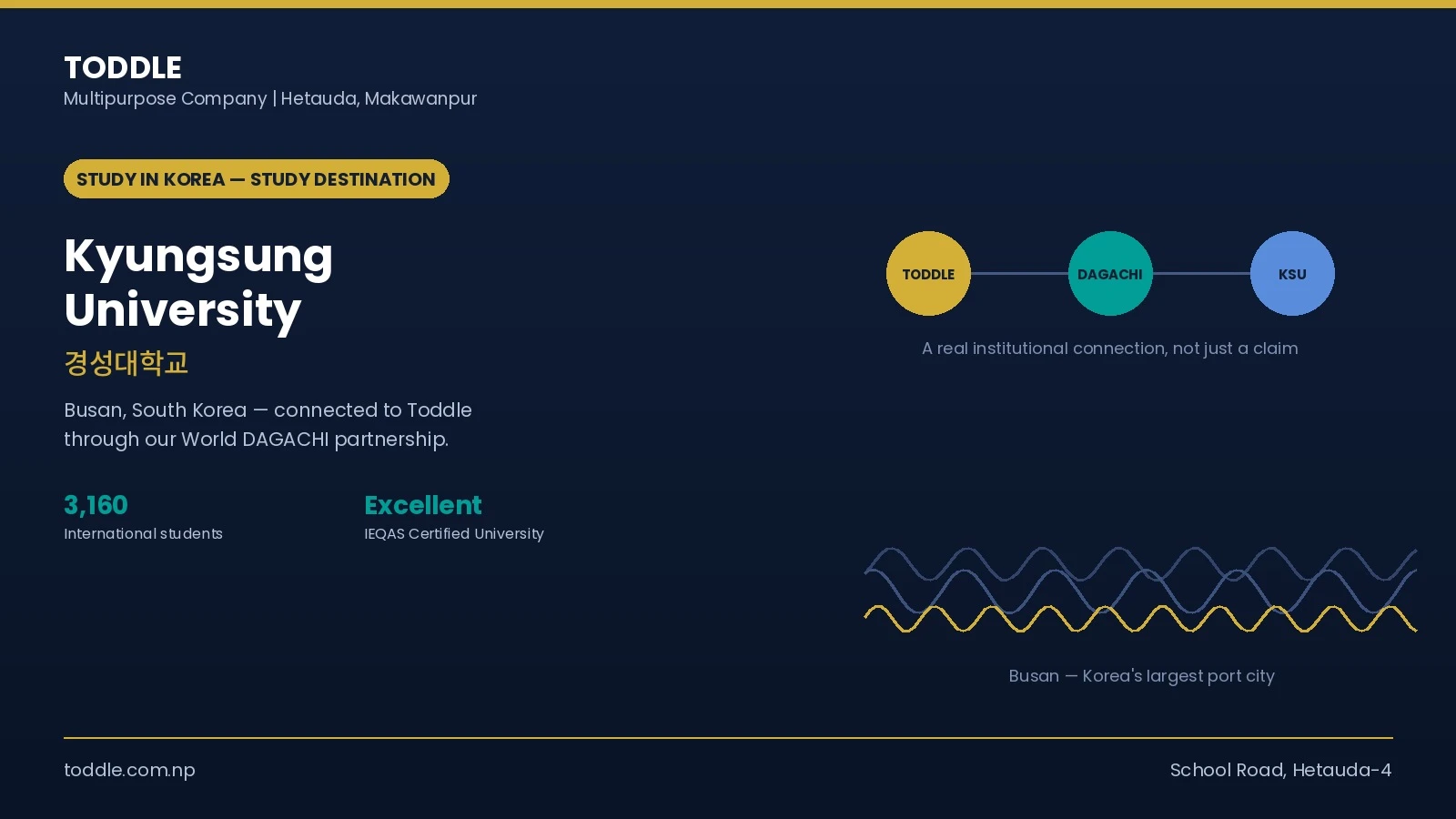
Kyungsung University
Study in South Korea: Kyungsung University (경성대학교)
Kyungsung University in Busan is a large, well-established comprehensive university with a genuinely substantial international student community — and it happens to be connected to Toddle in a way no other university on this site is. Read on for the full picture: its history, its real academic strength, and a partnership that puts our students in an unusually direct line of support once they arrive.
A Direct Connection: Toddle, World DAGACHI, and Kyungsung University
This is worth knowing upfront, because it's genuinely rare: on November 26, 2025, Kyungsung University signed an official cooperation agreement (MOU) with World DAGACHI, an AI-based multilingual communication platform company, specifically to strengthen support for international students — customized multilingual guidance services, cultural and life-adaptation programs, and regional settlement support built around the DAGACHI app.
Toddle's founder, Madhab Sapkota, serves as the official Nepal Representative of World DAGACHI. That means a Toddle student choosing Kyungsung University isn't relying on a vague promise of "support" — there's a real, traceable relationship connecting our office in Hetauda to a genuine partnership the university itself has built for exactly this purpose. We're upfront that this is a World DAGACHI–Kyungsung University partnership, not a direct Toddle–university agreement — but it's a real connection few, if any, other consultancies advising on this university can offer.
University History
Kyungsung University traces back to May 1955, when Rev. Kim Gil-chang founded Gyeongnam Sabeom Daesuk, a night-division four-year school built on Protestant Christian principles, aimed at training educators. It began with four departments — Korean Language and Literature, English Language and Literature, Mathematics, and Home Economics — in Seodaesin-dong, Busan.
The institution went through several transformations: reorganized in 1963 as Hanseong Women's Vocational Junior College, moving to Jung-gu; relocated to Yeongdo-gu in 1966; and moved to its current campus in Daeyeon-dong in 1973. It was upgraded to full four-year university status in 1979 as Busan Industrial University, and to comprehensive university status in 1983. It took its current name, Kyungsung University, in May 1988.
The university's founding motto is Truth, Service, and Freedom (진리·봉사·자유), rooted in its Christian founding spirit, with an educational goal centered on cultivating well-rounded talent with convergent knowledge, empathetic character, and creative ability.
Location
Kyungsung University is located in Nam-gu, Daeyeon-dong, in Busan — South Korea's second-largest city and its largest port, on the country's southeastern coast. The campus is directly connected to Busan's subway system, sharing a station (jointly named for Kyungsung University and neighboring Pukyong National University) that puts you within easy reach of the rest of the city, including nearby Gwangalli Beach.
Academic Structure
Kyungsung University is organized into eight colleges:
- College of Liberal Arts (문과대학)
- College of Social Sciences (사회과학대학) — including Police Administration, Media Communication, and Big Data Applied Statistics
- College of Business and Economics (상경대학)
- College of Natural Sciences (이과대학)
- College of Engineering (공과대학)
- College of Life and Health Sciences (생명보건대학) — a newer college established in 2021, home to departments including Bio-Safety and Cosmetics Science
- College of Pharmacy (약학대학)
- College of Arts (예술종합대학)
- College of Creative Talent (창의인재대학)
The university's department structure has genuinely evolved in recent years — some departments (including Dance, Political Science and Diplomacy, and Chinese Literature as a standalone department) were consolidated or closed due to declining enrollment and employment outcomes, while newer, more in-demand fields like Bio-Safety and Cosmetics Science were added. This kind of active restructuring is worth knowing — it suggests a university responding to real labor-market demand rather than standing still, but it also means specific department offerings can shift, so we always confirm current department status directly before you apply.
International Student Community and Accreditation
As of April 2026 official higher education statistics, Kyungsung University has 3,160 enrolled international students across degree programs, language training, and exchange programs — a genuinely large, established international community, not a small side program. The university's president publicly stated in 2023 a goal of growing to 3,000+ international students with an ambition to build a fully international College by 2030.
Kyungsung University is officially designated an Excellent Certified University (우수인증대학) under Korea's IEQAS system for the current certification period (March 2026–February 2027). If you've read our D2 Code Student Visa page, you'll know what this means practically: Kyungsung University students have access to CVI and E-Visa pathways across all D-2 subcategories, plus relaxed visa screening and extra part-time work hour allowances — genuinely useful if your academic profile falls below the current embassy GPA threshold discussed on that page.
Tuition and Scholarships
Kyungsung University's published tuition figures give us more to work with than some universities: average annual tuition across all tracks is approximately 6,580,000 KRW, with Humanities and Social Sciences programs running lower at approximately 5,470,000 KRW per year, and Natural Sciences, Engineering, Pharmacy, and Arts tracks typically higher. As always, exact figures vary by specific department and are set annually by the university — we confirm the precise current figure for your intended major before you apply.
The university disbursed approximately 40.7 billion KRW in scholarships in 2024 alone, averaging around 3,550,000 KRW per student — a substantial, genuine scholarship infrastructure worth asking about directly during your application process.
Campus Life
Kyungsung University's annual festival — recently renamed Libesta through a student naming contest — runs three days each May, with two days on campus and a final day held right on Gwangalli Beach, complete with concert-scale staging that draws general Busan residents, not just students. It's genuinely known across Korea as one of the standout university festivals in the country.
The university has also been recognized by Korea's Ministry of Employment and Labor as an excellent-grade (A-grade) institution for its work-study (IPP-type) program for four consecutive years — the only university in the Busan/Gyeongnam region to hold that distinction, reflecting real strength in connecting study to employment.
Why Consider Kyungsung University
- A large, established international student community (3,160+ students) with real institutional infrastructure to support it
- Excellent Certified University status under IEQAS — direct access to CVI and E-Visa pathways, and relaxed visa screening
- A genuine, traceable connection through Toddle's relationship with World DAGACHI, which itself has an official multilingual support partnership with the university
- Located in Busan — a major coastal city with a very different rhythm and cost of living than Seoul, without being a small or remote town
- Substantial scholarship funding and a strong, government-recognized work-study program
How Toddle Helps With Your Kyungsung University Application
- Guidance grounded in a real institutional relationship, not just general information — through our World DAGACHI connection
- Help identifying whether the standard visa route or the CVI/E-Visa pathway (available here as an Excellent Certified University) fits your academic profile
- Full document preparation and direct confirmation of current tuition and scholarship options for your intended department
- Complete visa counselling from application through arrival — see our Study in Korea, D2 Visa, and D2 Code pages for the full process
Frequently Asked Questions
What is the real connection between Toddle and Kyungsung University?
Kyungsung University has an official partnership with World DAGACHI for international student support, and Toddle's founder is World DAGACHI's Nepal Representative. It's a genuine, verifiable relationship — not a direct Toddle-university agreement, but a real connection nonetheless.
Does Kyungsung University's Excellent Certified status actually help me?
Yes — it means CVI and E-Visa pathways are available across all D-2 subcategories, along with relaxed visa screening, which matters especially if your GPA is below the current embassy threshold discussed on our D2 Code page.
How much does it cost to study there?
Average annual tuition is approximately 6,580,000 KRW overall, with Humanities and Social Sciences programs running lower — but we confirm the exact current figure for your specific department before you apply.
What is Busan like as a place to study, compared to Seoul?
It's Korea's second-largest city and largest port, with a real urban environment and its own distinct culture and coastline — generally a lower cost of living than Seoul, without being a small town.
Interested in Applying to Kyungsung University?
Come talk to us at our Hetauda office — we'll walk you through the departments that fit your goals, explain how our World DAGACHI connection can support you once you're there, and confirm real, current costs before you commit to anything. Prefer to start from your phone? WhatsApp us at +977 9769741767 and we'll get you started.
University information is drawn from official Korean-language sources and is subject to change; we confirm current department offerings, admission requirements, and tuition directly with the university before you apply.