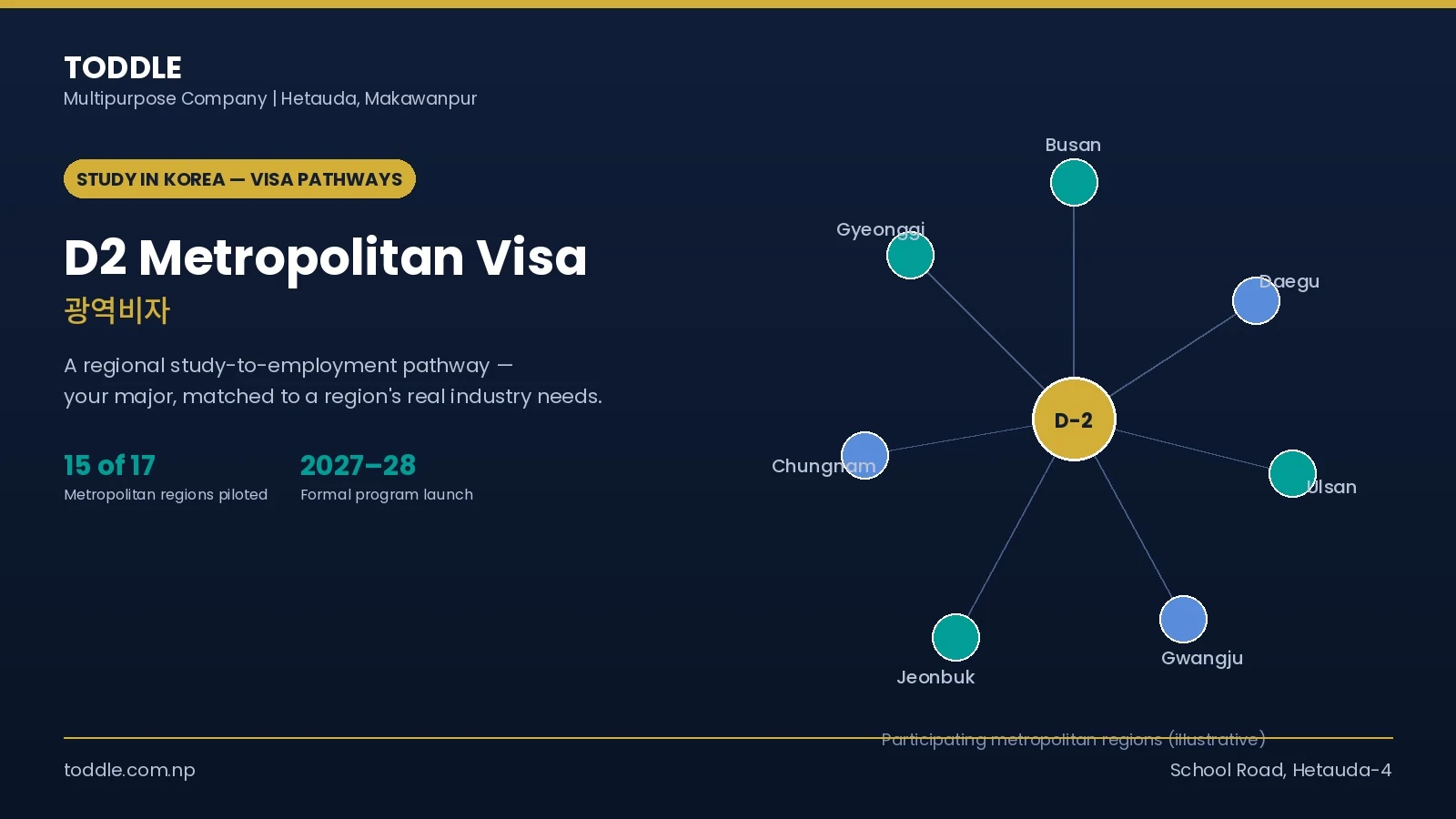
D2 Metropolitan Visa (광역비자) Counselling Services
D2 Metropolitan Visa (광역비자) Counselling Services
Most D2 pathways on this site — the standard route, D2 Code, and E-Visa — are about how your visa gets processed. The Metropolitan Visa is different: it's about why and where. This is a genuinely purpose-built pathway, created by Korea's Ministry of Justice specifically to connect international students to the regional industries that need them, with real employment tied to your degree from day one. This page explains exactly what it is, how it works, and whether it fits your goals.
What Is the D2 Metropolitan Visa?
The Metropolitan Visa (광역형 비자) is a Korean government program that lets provincial and metropolitan-level local governments design their own visa conditions, tailored to their region's specific industrial and workforce needs — rather than every region following one uniform national standard. Local governments identify the talent their industries actually need, recommend qualifying candidates, and the Ministry of Justice reviews and issues the visa based on those regionally-designed conditions.
For students, this applies to a specific kind of D-2 visa: pursuing a bachelor's degree or higher, in a field connected to that region's industrial needs, with employment in that region built into the pathway after graduation. It isn't a general study visa — it's a study-to-employment pipeline, by design.
Why This Program Exists — Its Specific Purpose
Korea is facing a demographic and labor shortage challenge, particularly outside the Seoul metropolitan area. The Ministry of Justice created the Metropolitan Visa specifically to address this: connecting education, employment, family settlement, and long-term regional residency into a single coordinated system, rather than treating student visas and work visas as separate, disconnected processes. According to the Ministry's own evaluation, the program has measurably helped ease labor shortages in provincial industries, with little effect on jobs or wages for Korean workers — a genuinely positive, government-verified outcome, not just a policy intention.
How It's Different From D2 Code and D2 E-Visa
| Pathway | What Determines Eligibility | Who Sets the Rules |
|---|---|---|
| D2 Code (CVI) | Your university's national IEQAS certification | Ministry of Education / Ministry of Justice, nationally |
| D2 E-Visa | Your university's IEQAS certification and program level | Ministry of Education / Ministry of Justice, nationally |
| D2 Metropolitan Visa | Your chosen region's participation, your major matching that region's industry needs, and a post-graduation employment commitment | Provincial/metropolitan government, reviewed and issued by the Ministry of Justice |
In short: CVI and E-Visa are about which university you attend. The Metropolitan Visa is about which region you're willing to build your career in.
Current Scale and Status — From Pilot to Formal Program
This program was announced in December 2024 and has run as a pilot across 2025 and 2026, operating in 15 of Korea's 17 metropolitan-level local governments (all except Daejeon and Sejong). During this pilot period, a total of 6,790 visa places were allocated, with over 2,600 foreign nationals already residing in Korea under this system.
As of late August 2026, the Ministry of Justice announced this program is moving from pilot status into a formal, ongoing program for 2027–2028 — meaning this is no longer a short-term experiment, but a system Korea is actively building into its long-term immigration policy. Several rule changes come with this transition, worth knowing if you're planning ahead:
- Local governments can now select students under both D-2 and E-7 categories together, rather than being limited to just one
- The number of visa slots per metropolitan government has been adjusted to 50–200 places (tightened from a much wider 60–1,000 range during the pilot), allowing more focused, better-managed selection
- The total nationwide quota has been reduced to approximately 3,000 places for the new cycle, down from 6,790 during the pilot — reflecting a more targeted, quality-focused approach rather than pure volume
- D-2 eligibility is now explicitly linked to majors matching demonstrated regional industry demand — meaning your field of study needs to genuinely align with what that region's employers are looking for, not just any bachelor's program
Who Should Consider the Metropolitan Visa Pathway
- Students pursuing a bachelor's degree or higher who are genuinely open to living and working in a specific Korean region — often outside Seoul, Incheon, or Gyeonggi Province — rather than insisting on a major-city location
- Students whose intended field of study aligns with industries a specific region has identified as needing workers
- Students who want a clearer, more structured path from graduation directly into regional employment, rather than searching independently after finishing their degree
- Students choosing between similar university offers, where one happens to be in a participating Metropolitan Visa region
Why Work With Toddle on the Metropolitan Visa Pathway
- We track which regions are currently participating and what industries each one is prioritizing, since this shifts as the program moves into its formal 2027–28 phase
- We help you honestly assess whether your intended major genuinely matches a participating region's demonstrated industry need — this is now a hard eligibility requirement, not a loose guideline
- We explain the real post-graduation employment commitment involved, so you're making an informed decision, not just chasing a visa advantage
- We compare this pathway against the standard D2 route, CVI, and E-Visa, so you choose based on your actual career goals
Frequently Asked Questions
Is the Metropolitan Visa the same as the "region-specific visa" for population-declining areas?
No — these are two separate Korean government programs. The population-decline area program (지역특화형 비자, covering F-2-R, E-7-4R, and F-4-R statuses) operates at the district level and began in 2022. The Metropolitan Visa operates at the province/metropolitan-city level, was announced in December 2024, and specifically covers D-2 and E-7. We can explain which, if either, applies to your situation.
Do I have to work in that region after I graduate?
Yes — regional employment is the core design of this pathway, not an optional add-on. This is meaningfully different from a standard D2 visa, where you're free to seek work anywhere in Korea after graduation.
Is my major eligible?
Only if it matches a participating region's demonstrated industry demand — this became an explicit requirement in the program's 2027–28 formal rules. We check current regional priorities with you directly.
Is this a pilot program I shouldn't rely on, or is it stable?
It began as a two-year pilot, but as of August 2026, the Ministry of Justice has committed to launching it as a formal program for 2027–2028 — a genuine sign this is becoming a lasting part of Korea's immigration system, not a temporary experiment.
How is this different from CVI or E-Visa?
CVI and E-Visa are about how your visa gets processed, based on your university's national certification. The Metropolitan Visa is about regional employment planning — it's a different kind of decision entirely, based on where you're willing to build your career, not just which university accepted you.
Curious Whether the Metropolitan Visa Fits Your Plans?
Bring your intended field of study and any university offers you're considering to our Hetauda office, and we'll tell you honestly whether a Metropolitan Visa region fits your goals — or whether the standard route, CVI, or E-Visa serves you better. Prefer to start from your phone? WhatsApp us at +977 9769741767 and we'll walk you through it.
This program is transitioning from a pilot phase into a formal Korean government program for 2027–2028, and its participating regions, eligible majors, and specific terms continue to develop. We confirm the current status directly with you during your consultation.