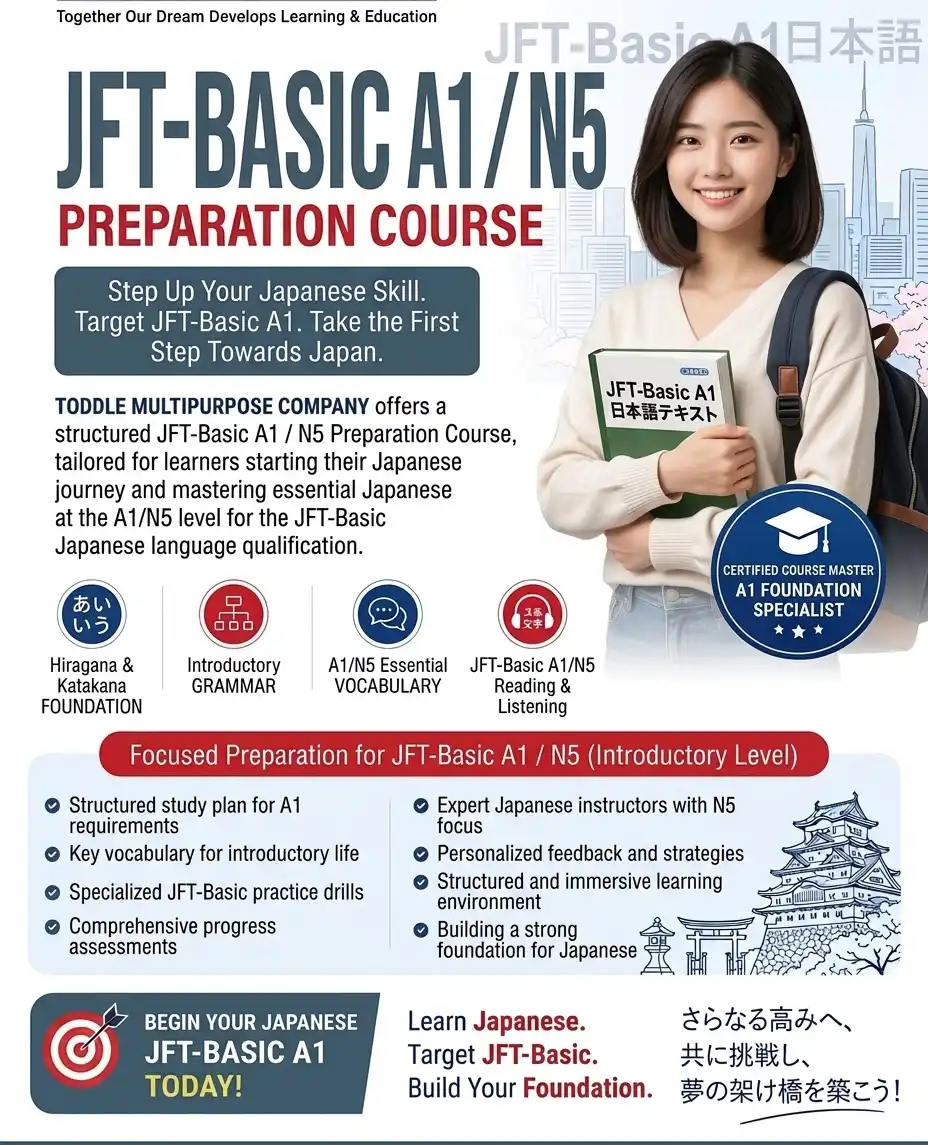
JFT-Basic A1 / N5 Preparation Course
If you're applying for the Specified Skilled Worker visa to work in Japan, "JFT-Basic" is very likely the test standing between you and that visa — not JLPT, not NAT-TEST, not J-CERT. Those three are study-track tests. This one is built for work.
"JFT-Basic" (Japan Foundation Test for Basic Japanese) is administered by the Japan Foundation, delivered through Prometric testing centers. It sits at roughly CEFR A1–A2 level — comparable in difficulty to JLPT N5/N4 — but its actual purpose is different: it exists specifically to satisfy the language requirement for the "Specified Skilled Worker" ("Tokutei Ginou") visa route.
This course is built around that goal. Not academic grammar drills, not exam theory disconnected from real life — practical, workplace-focused Japanese matched to what JFT-Basic actually tests.
What Is JFT-Basic? (And Who Actually Needs It)
JFT-Basic tests whether you can function with basic Japanese in daily life and on a Japanese job site — understanding instructions, reading signs and notices, following simple workplace communication. It's deliberately practical rather than academic.
JFT-Basic is required specifically for the Specified Skilled Worker visa route, not for language school admission — if you're applying to study in Japan, you want JLPT, NAT-TEST, or J-CERT instead, not this course.
For SSW eligibility, the Japanese-language requirement is satisfied by either JFT-Basic (scoring 200 or above) or JLPT N4 or higher — the two are treated as interchangeable options across SSW sectors, not sector-specific alternatives. Most candidates choose JFT-Basic because it's offered far more frequently than JLPT and tests more directly practical, workplace-oriented Japanese. On top of the language requirement, each SSW sector also has its own separate skill evaluation test — JFT-Basic alone doesn't complete your visa eligibility, but it clears the language half of it.
JFT-Basic Eligibility and Who Should Take This Course
- Applicants targeting an SSW work visa category, in any sector
- Complete beginners in Japanese, or those with a little prior exposure
- No academic prerequisite — this is a practical, work-oriented entry point, not a continuation of formal Japanese study
If you're unsure whether your target sector accepts JFT-Basic or specifically wants JLPT N4, ask us before you start preparing — we'll confirm it rather than let you guess.
What You'll Learn in Toddle's JFT-Basic Preparation Course
- Hiragana and Katakana — enough to read basic signs, notices, and instructions
- Everyday and workplace vocabulary — the words you'll actually encounter on a Japanese job site
- Simple, practical grammar — matched to real conversation, not academic sentence analysis
- Listening for real-life and workplace situations — instructions from supervisors, announcements, everyday exchanges
- Reading practice for signs, notices, short messages, and simple instruction manuals
[confirm exact syllabus breakdown]
JFT-Basic Exam Format and Test Dates
JFT-Basic is a computer-based, adaptive test (CBT), taken at an approved Prometric testing center.
- Sections: Script & Vocabulary, Conversation & Expression, Listening, and Reading
- Total questions: around 50, roughly split evenly across the four sections
- Duration: about 60 minutes
- Scoring: a scaled score from 10 to 250
- Pass mark: 200 points, corresponding to A2 level ("can function in real-life situations")
- Results: available immediately after the test
Test frequency: JFT-Basic runs far more often than JLPT — many dates throughout the year rather than twice-yearly sittings, which is exactly why most SSW candidates choose it over JLPT N4.
Nepal test venue: the Prometric testing center in Kathmandu.
Test fee: around NPR 4,500–6,000, set by the Japan Foundation via Prometric (confirm the exact current fee, as it can be revised)
Retakes: if you don't pass, you can generally retake the test after 45 days.
Toddle JFT-Basic Course Highlights
- Curriculum built around real JFT-Basic question formats and everyday/workplace Japanese — not academic grammar drills disconnected from what the test or the job actually needs
- Regular mock tests matched to the CBT format and timing
- Small batch sizes
- Guidance connecting your JFT-Basic result to your specific SSW visa application — since passing the language test is only one part of your overall SSW eligibility
- [confirm instructor credential for Japanese-language teaching]
Course Duration, Schedule & Fees
- Duration: around 2 to 3 months, matching typical A2-level workplace Japanese prep courses in the region
- Schedule: morning and evening batches, typically 3–4 sessions a week — ask at the office for the current timetable
- Fee: around NPR 15,000–20,000 for the full course (confirm exact current fee with our office)
Given how frequently JFT-Basic is offered, ask at the office about the nearest available test date once you're ready.
What Happens After the JFT-Basic Course?
- Apply for your SSW visa with your JFT-Basic result (200+) as your language-requirement credential
- Complete your sector's skill evaluation test, since JFT-Basic covers only the language half of SSW eligibility
- Consider JLPT N4 instead if a specific employer or agency you're working with prefers it, though the two are generally treated as interchangeable for SSW purposes
We'll help you map out your full SSW eligibility checklist, not just the language test, before you finish this course.
Frequently Asked Questions About the JFT-Basic Course
What is JFT-Basic, and who needs to take it?
It's a practical, work-oriented Japanese test administered by the Japan Foundation, required for the Specified Skilled Worker visa. Anyone pursuing SSW work in Japan needs either this test or JLPT N4.
Is JFT-Basic the same as JLPT N5?
Not exactly — they're roughly comparable in difficulty, but JFT-Basic tests practical, workplace-oriented Japanese through an adaptive computer test, while JLPT N5 is a paper-based academic exam. They serve different purposes: JFT-Basic for work visas, JLPT for study and general proficiency.
Do I Need JFT-Basic or JLPT N4 for the Specified Skilled Worker Visa?
Either satisfies the SSW language requirement — JFT-Basic (200+ points) or JLPT N4 or higher. Most candidates choose JFT-Basic because it's offered far more frequently and tests more directly practical Japanese. Your specific employer or sector may have a preference, so confirm before committing to one track.
How is the JFT-Basic exam conducted?
It's a computer-based, adaptive test taken at a Prometric center — in Nepal, that's Kathmandu. It runs about 60 minutes across four sections, with results shown immediately.
Do I need any prior Japanese knowledge to join this course?
No. This course starts from the basics, including Hiragana and Katakana, for students with zero background.
What happens after I pass JFT-Basic?
Your language requirement for SSW is met. You'll still need to pass your sector's separate skill evaluation test before your full SSW eligibility is complete.
What is the JFT-Basic pass mark?
200 out of 250 points, corresponding to A2 level on the test's "can-do" proficiency scale.
How many sections does the JFT-Basic exam have?
Four: Script & Vocabulary, Conversation & Expression, Listening, and Reading — roughly 50 questions total.
How much does the JFT-Basic exam cost in Nepal?
Around NPR 4,500–6,000, set by the Japan Foundation through Prometric. Confirm the exact current fee before registering, as it can change.
Where can I take the JFT-Basic exam in Nepal?
At the Prometric testing center in Kathmandu.
How often is JFT-Basic offered in Nepal?
Much more frequently than JLPT — multiple dates throughout the year rather than a fixed twice-yearly schedule, which makes it easier to fit around your visa timeline.
Can I retake JFT-Basic if I don't pass?
Yes, generally after a 45-day waiting period.
Is JFT-Basic harder or easier than JLPT N4?
Neither is inherently harder — they test different things. JFT-Basic focuses on practical, real-life and workplace communication through an adaptive CBT; JLPT N4 tests grammar and reading through a traditional paper exam. Many candidates find JFT-Basic's practical focus more directly useful for SSW preparation.
Does passing JFT-Basic guarantee my SSW visa?
No — it satisfies only the language-requirement portion. You'll still need to pass your specific sector's skill evaluation test and meet the other SSW application requirements.
Can I switch from JFT-Basic prep to JLPT N4 prep if my plans change?
Yes, though it means adjusting to a different exam format. Tell us early if there's a chance you'll need JLPT N4 instead, so we can plan your preparation accordingly.
Ready to Start Your JFT-Basic Preparation?
Book a seat in the next Hetauda batch, or WhatsApp us at +977 9769741767 — and confirm with us which language test your specific SSW sector and employer actually require before you commit to a track.